All posts by M.J.

#318: Toward a Seventh Multiverser Novel

This is mark Joseph “young” blog entry #318, on the subject of Toward a Seventh Multiverser Novel.

I have mentioned this to my Patreon patrons, so if you’ve been following me there you already know something of what I am about to ask–and I am asking, seeking the opinion of my readers, which you can express here, by Patreon, on Facebook, or through any of the other social media connections I maintain (Twitter, Pinterest, Goodreads, LinkedIn).  Please don’t e-mail me–I have given up on e-mail, and your correspondence will bounce.

If you are reading this, odds are a lot better than even that you are at least aware that I have been writing novels and publishing them free through the Internet, several short chapters each week.  Six books have now been written, and the fifth has been published and the sixth started.  If you’ve somehow missed these, you can catch up:

  1. Verse Three, Chapter One:  The First Multiverser Novel
  2. Old Verses New
  3. For Better or Verse
  4. Spy Verses
  5. Garden of Versers
  6. Versers Versus Versers

Obviously at this moment the last of those is not yet fully published.  That makes this difficult, because I have to ask you something that requires you consider what you know and extrapolate what you don’t know.  Worse, I wanted to do this without giving spoilers, but on reflection it seems that I am going to have to give you at least the flavor of the situation of each of the characters at the end of the sixth book, and that’s going to be spoilers.  I will warn you where to stop reading to avoid the spoilers which pertain to the material not yet published; if you haven’t read any of the novels, or even if you haven’t kept up with everything published to date, there will be spoilers, and that can’t be helped.  Either go read the books or live with the spoilers.

In the first of those I introduced three main characters, what I’ll be calling “viewpoint” characters because they’re the characters through whom the story is seen and presented.  Each is followed individually, and they join together toward the end of the book.  In the second book, one of those characters took a break and we added a new one, again bringing the three characters together toward the end of the book, and in the third and fourth we shuffled which three characters were involved in the story and which took a break.

In the fifth book, a fifth viewpoint character was introduced, and all five were involved in stories.  Those five come together, sort of, in the sixth book, and a sixth character is introduced on her own storyline.

Right from the beginning–before the first book was completed–I had a notion that I was going to share this effort with someone else, that at some point we together would create some new characters and then we would spin them off into a separate series which he would write.  The introduction of the fifth character was in my mind the beginning of that, but that expectation faded during the writing of that book and even more as the sixth character was introduced.  At this point I’m fairly certain it is not going to happen–but I have six active viewpoint characters, and that was manageable in the sixth book when most of them were in the same universe most of the time, but to continue that way would make all the stories too thin in the seventh book.  I am thus faced with which characters to include in the next book and which ones to set aside for a hopefully likely future story–and I’ve decided that at least part of that decision will be based on what you, the readers, want, which characters you would like to follow.  So let me present to you the options, and you can give me your opinion.

Two options should be mentioned up front.  The first is you can choose not to respond at all.  If I get little or no response I will give serious consideration to dropping the novels, as although they are enjoyable in the main, they do take time, and I don’t think many of my patrons are supporting me primarily for those.  The second is like it:  you can tell me that you consider the novels to be a waste of my time, and that I should be putting that time into something else–the time travel movies, more Bible pages, more politics and law, that second edition of Multiverser that has long been back-burnered, whatever you think should be my focus.  I’m not saying it’s a democracy, but I am saying that your opinion matters.  Even if your advice doesn’t cause me to drop the novels, it might cause me to do more in whatever area you hope to see (and the more so if you are one of my Patrons).

Otherwise, tell me which characters you’d most like to see in the seventh novel, perhaps why, perhaps what hopes you have for their futures.  I’m going to tell you a little about each of them here, some of it on the edge of spoilers, to help.  To borrow a line from the credits of an old Blackadder episode, the characters are being listed in something like The Order of Disappearance.  I don’t want to tell you what happens in the end of Garden of Versers, but I will tell you this much, that only one viewpoint character is still in the world in which he or she begins when the book ends, and in the spoilers section toward the end you’ll probably be able to figure out which one.  If you already have one or more favorite characters whose story you would prefer to follow, you can stop reading here and express your opinion through one of those avenues (here, Patreon, Facebook, Twitter, Pinterest, Goodreads, LinkedIn).  For what it’s worth, I have already drafted a “next chapter” for five of them, so I’ve got a good solid start whichever way it goes.

Derek Jacob Brown was not in the first novel at all.  He was introduced in the second, which was in a sense very much about him, about dealing with his fears.  He has been in every novel since, but in the second he comes in as the sprite Theian Toreinu Morach then learns how to transition from one “person” to the other, with the creation of his middle form Ferris Hoffman incidental to that.  He trains as a secret agent and goes on a number of missions in book four, and in book five after proving himself an invaluable hero he gets married.  Book six begins the story of his married life.  There is a solid argument that since he has been in the last five consecutive books he is a prime candidate for omission from the next.

Robert Elvis Slade, often called by a considerably longer titled name but just as often simply by “Bob”, was in some sense the main character of the first book.  There he goes from an ordinary guy with delusions of greatness to the hero of the story–and because of this, I instinctively omitted him from the second book.  (He appears as a supporting character in some of Lauren’s early chapters, but is never the viewpoint character in that book.)  He returned in the third, because the first had left some loose ends and I had decided to bring Shella back into his life, whom he married while they were on a mission.  Then they assisted Lauren, worked with Joe in book four, and came to the main world of book five (at the end book four).  Slade fancies himself a Warrior of Odin, and is always ready for a battle, at which he is very good.  He assumes that wherever he is he is there to hone his skills for Ragnorak.  Meanwhile, he’s also in some ways the most fun character, just a bit of a clown in everything, and I know he has fans who like the way he lightens the stories.

Joseph Wade Kondor, or Joe, who has adopted the rank of Captain and earned the title Doctor, was omitted from the third book partly because I decided it was his turn, but largely because the third book would complete Lauren’s major story of confrontations with vampires, and his persistent atheism would have been a complication in that story that I didn’t particularly want either for the story or for the character.  That atheism is a defining feature, as he attempts to make sense of a reality around him by finding perfectly natural scientific explanations for abilities and phenomonema his friends believe to be magic.  He also deals with the conflict that he is against killing but frequently finds it necessary.  At the end of the fourth book he accidentally picked up a companion, Ezekiel “Zeke” Smith, who is also a soldier and something of a skeptic of Kondor’s skepticism.

Lauren Elizabeth Meyers Hastings finished a major story of a battle against vampires across time with the end of the third book, and so sat out the fourth.  She returned in the fifth in a story that attempted to challenge her reality, as a patient in a mental hospital, but then joined the others at the end of book five to become part of the team in book six.  She is something of a superhero in the stories, as good as or better than any of the others at just about everything, but constantly teaching and training them to be better.  The major obstacle in her stories is finding an interesting adversary that actually challenges her abilities without turning it into an ongoing battle.

James Donald Beam came into the story in the fifth book as something of an antihero.  He is curmudgeonly and always self-serving, although he has managed to gather something like an adventuring party around himself by making their interests correspond with his own.  The team includes Turbirb’durpa, nicknamed “Bob”, an alien with significant psychic abilities but not much else going for him; Dawn Project Prototype Unit Number X Dash Zero Zero, or “Dawn” for short, a child-like humanoid killing machine who follows orders quite strictly; Bron, burly blacksmith with whom he apprenticed and part-time fighter and wizard; and the witch Sophia, his almost accidental wife.  It’s also clear that he is not heroic, and not likely to be the star of a heroic tale, except in the accident that it proves to be in his own best interests to do something that incidentally helps others.

Finally, Tomiko Takano appears beginning in book six, so you have just met her.  She is a modern Japanese-American teenager not particularly interested in her Japanese culture who has not yet figured out what’s happening to her.  She goes through a couple worlds that challenge her conceptions of reality.  The best argument for including her is that she is so unknown, a fresh face in the stories.  She may also be hardest to write, but then, if I didn’t like a challenge I wouldn’t have created her.

So the question, once again, is whose stories would you, as a reader, like to see continued in book seven?  At the moment there is no clear plotline, not so much as a working title–but those things will arise once we have characters beginning a story.  It’s not an election, and your opinions are non-binding, you’re welcome to vote for all of them if you like (although that will reduce the influence of your vote, because I’m pretty determined that they won’t all be in the next book).  Characters not chosen for this book are expected to return in the future.

Now for the spoilers.  If you don’t want to know what is going to happen, you can certainly express your opinion based on your knowledge of the characters without reading further, through the aforementioned means (here, Patreon, Facebook, Twitter, Pinterest, Goodreads, LinkedIn).

Derek has already started a new story in another universe, a familiar “lost colony spaceship” trope with some twists, and his is also a story already rolling–I have both a “next chapter” and a “later chapter” drafted for him.  It is a promising start for a story, but will probably be rather cerebral for the foreseeable future.  Thematically it’s probably about the value of human beings.  He is at something of a cerebral cliffhanger, and I can see readers wanting to know what happens next–which plays strongly against the point that his story has been running for five consecutive books and he should take a break.

Slade has landed in a world which has potential for some interesting ideas, but not a lot of obvious action.  It’s one of those worlds that a referee launches because he thinks it might have interesting possibilities but he has no idea what they are.  It is a nineteenth century industrial revolution setting, but in an alien world to which he has a previous connection.  I have written the next three chapters of his story, and I know where it’s going but not quite how it gets there.

Joe has reached a place where there is some immediate action, a definite cliffhanger, but beyond that it’s not at all clear what he would be doing.  He is in a sense reaching the climax of the story of book five, an impending battle which should lead to a denoument, but I don’t know what will happen after that.  So I suppose it’s an immediate cliffhanger but promising a quick resolution and not much beyond that.  His next three chapters are written, but I don’t know what happens after that.

Lauren is the most open, as she has just left a universe and not yet arrived in another, so she could be anywhere.  On the other hand, events leading to her most recent death will have given her something to consider, and I’m contemplating putting her somewhere with someone with whom she can discuss these events.  I am undecided.  It would be good to have her discuss these issues with Merlin/Omigger, but I don’t have a clear picture of a good world for that.  The problem is that I don’t have another character I can reasonably bring into her story whom she would treat as an advisor on such topics, so it won’t be easy to transition to that kind of story for her.  I’ve been given some fan advice on possible challenges for her, but nothing has coalesced yet.  I am also giving serious thought to dropping her into a Dungeons & Dragons-type world, different from Bob’s opening dungeon crawl because she would be meeting a group of adventurers already on a mission.

I debated where to send Beam, and kept thinking of the same universe.  He is now there.  There is probably a broad outline of a storyline ahead based on the fact that the player who is the primary inspiration for his character was in this world and did quite a few things while there, but nothing is particularly compelling at the moment.  Problematically, his situation shares enough in common with Derek (despite being entirely different) that there’s a good argument for not continuing both of them in the same book.  They are both post-civilization worlds, post-apocalyptics without the apocalypse, but that Derek is in space and Beam is underground (The Industrial Complex from The Second Book of Worlds).  So there are strong arguments for continuing the Beam story, including that it would be only his third book, and he is very different from the other viewpoint characters, but not if Derek’s story is going to be included.  I have also written three chapters for him, but he is only just settling into this world and I haven’t figured out how to move him forward.

Tomiko oddly managed to arrive in a rather dull and ordinary world just in time for something dramatic and extraordinary to happen and sweep her into it.  She has in that sense begun a new story for which I have the next three chapters drafted and some sketchy immediate notions but no clear long-term plotline.  It doesn’t promise an exciting story, but you never can be sure.

Let me know your thoughts (here, Patreon, Facebook, Twitter, Pinterest, Goodreads, LinkedIn).

Thanks for your input, support, and encouragement.

#317: The Song “That’s When I’ll Believe”

This is mark Joseph “young” blog entry #317, on the subject of The Song “That’s When I’ll Believe”.

That’s When I’ll Believe.

As far as favorite songs go, this was only number twelve of my top choices, and tied for thirteenth of Tristan’s; but it ranked number two in quality of recording and performance.  (See previous web log posts, linked below, for more about the ranking system.)  I have some quibbles–I missed a vocal frill I never miss, Baxter didn’t get all the guitar frills and chord positions the way I would have done them, and I forgot that there was brass at the climax of the last verse so I didn’t record it–but overall it’s an excellent recording, and the one that appears on the EP Collision Of Worlds.  You’ll find it here.

In the studio, I had Kyle Baxter record the acoustic guitar for the first verse alone in the booth.  He hesitated on the last chord and apologized to me for it saying he could do it again, but I said it would work fine that way.  We then had everyone in the booth to record the body of the song, with my singing and Nick Rhoades’ gentle cymbals over that first verse before everyone came in (Jonathan Maness on keyboards, me on bass) for the rest.  In concert we had two keyboards, and Jonathan was supposed to put the brass in, but there was only one in the studio so we went back and I overdubbed the brass on the keyboard.  I hadn’t practiced it, and was doing it from my recollection of a midi recording I’d made a decade earlier, but it worked.

Because the song was recorded by Collision and previously done by Cardiac Output, there are already pages on the Web which discuss it, most notably here, telling the story of its origin.

Some people try to tell me my way’s no good,
That I’ve got to take another path.
If there’s a God in heaven I really should
Turn around and so escape His wrath.
If there’s a God in heaven, then what is death?
The Grim Reaper leaves us all bereaved!
So when I hear of someone calling back his breath,
That’s when I’ll believe.

They say there was a man who conquered the grave–
Yes, they say He rose up from the dead.
High on a cross He suffered and died to save
With a crown of thorns upon His head.
I’ll have to see the nail prints in Jesus’ hand,
And the side the soldier’s sword has cleaved,
And when I’m satisfied and sure I understand,
That’s when I’ll believe,
That’s when I’ll believe.

They say He’ll come again in power–
Then He will take His people home.
Although nobody knows the hour,
Still they are sure that He will come.
When I see Him in the clouds–
When His people start to leave–
When the trumpet sounds aloud–
That’s when I’ll believe.

They say that Christ will judge the good and the bad:
Everyone will get what he deserved.
Those who have followed Him will no more be sad.
For the rest, the fire’s been reserved.
So when I’m in the fire that never dies,
When I have no hope to be relieved,
I will remember doubting, and I’ll wonder why.
That’s when I’ll believe,
That’s when I’ll believe.

I can only hope you benefit from the song in some way.  I will continue with additional songs in the future.

*****

Previous web log song posts:

#301:  The Song “Holocaust” | #307:  The Song “Time Bomb” | #311:  The Song “Passing Through the Portal” | #314:  The Song “Walkin’ In the Woods”

Next song:  Free

#316: A Gather World

This is mark Joseph “young” blog entry #316, on the subject of A Gather World.

With permission of Valdron Inc I have previously completed publishing my first four novels, Verse Three, Chapter One:  The First Multiverser Novel, Old Verses New, For Better or Verse, and Spy Verses, in serialized form on the web (those links will take you to the table of contents for each book).  Along with each book there was also a series of web log posts looking at the writing process, the decisions and choices that delivered the final product; those posts are indexed with the chapters in the tables of contents pages.  Now as I have posted the fifth, Garden of Versers, I am again offering a set of “behind the writings” insights.  This “behind the writings” look may contain spoilers because it sometimes talks about my expectations for the futures of the characters and stories–although it sometimes raises ideas that were never pursued, as being written partially concurrently with the story it sometimes discusses where I thought it was headed.  You might want to read the referenced chapters before reading this look at them.  Links below (the section headings) will take you to the specific individual chapters being discussed, and there are (or will soon be) links on those pages to bring you back hopefully to the same point here.

There is also a section of the site, Multiverser Novel Support Pages, in which I have begun to place materials related to the novels beginning with character papers for the major characters, giving them at different stages as they move through the books.

This is the eleventh and final mark Joseph “young” web log post covering this book, covering chapters 121 through 132.  Previous web log posts covering this book include:

History of the series, including the reason it started, the origins of character names and details, and many of the ideas, are in those earlier posts, and won’t be repeated here.

Chapter 121, Slade 153

I had been juggling this in my mind for some time, but it was still jumbled when I did the first draft.  Part of it was I didn’t want the Caliph talking through the entire chapter, and part of it was I wanted to have some of it discussed quietly behind the scenes but didn’t really want two scenes from this.  I had put together the details quite a bit before reaching this point, but hadn’t really cemented the presentation.


Chapter 122, Beam 36

I wanted another encounter with a smaller mechanical, and this seemed the best way to guarantee that I got it.  I decided that a shotgun probably wouldn’t be enough to damage it, and particularly that you couldn’t get close enough with a shotgun before it killed you, but I wanted Bron to shoot first.  I also figured that a grenade would probably be enough, given the accuracy of Dawn’s shooting.

The problem with opening the door was one I’d had in mind since their departure, and between there and here I worked out that Bron would be the solution, using his blacksmithing equipment.

I also decided that this was a good place to explain that Bob knew when attackers were coming because he heard their thoughts, and thus he did not know when machine attackers were coming.


Chapter 123, Brown 178

I had played this in my head a couple times, but couldn’t quite get the detail right.  One of the big bits was what Derek should call the Amir; I also needed to explain why he hadn’t done this already, and thus the reason why the Amir was in the city now but had not been earlier.


Chapter 124, Beam 37

I needed to put the marriage in place as at least sort of working, without disrupting the Beam character or making it all copacetic.  I also wanted to avoid sex scenes, which I had to this point avoided with Slade and Shella and would be avoiding with Derek and Vashti.  That didn’t mean they wouldn’t be mentioned.

At this point I had four more Beam chapters slated, thanks to the reorganization.  I had a rough draft of the fourth, in which they arrived in the next world, which meant that in the first they had to make a decision about which way to go which would result in the third in them being killed (I had an idea of what killed them, but it would require them to be in the open).


Chapter 125, Hastings 171

I knew I had to find a credible way to kill Lauren, and I had some ideas, but none of them were workable until I thought of them drugging her.


Chapter 126, Beam 38

At this point I was struggling with the story.  I had wanted Beam to lead the team outside, so that I could knock them out of this world into the next, but I had the same problem he had:  there wasn’t any good reason for them to do so.  Thus instead I was faced with the problem of trying to figure out what they would find if they searched the entire bunker.

I also hit a snag when I started to write about Sophia cooking for them, because of course Beam is a cook and likes to cook.  However, I saw Sophia trying to be “wifely”, and cooking is a natural part of that.  That led to the fact that she generally cooked on wood fires, and needed to be shown how to use more modern technology.

My upgraded outline now gave me the space of two chapters, which I could reduce to one but could not easily expand to three, in which to put Beam in a position to verse out for my final chapter in the new world.


Chapter 127, Kondor 154

I had had Kondor muse briefly on marriage when Bob introduced Shella as his wife at the beginning of the previous book; now that Derek and Vashti were getting married, there was another opportunity to challenge the skeptical view he took of such matters.


Chapter 128, Beam 39

Before I wrote this I knew I was headed into a battle, and that I had set up the notion that some of Sophia’s magic worked, so I was going to need to know what she actually could do in a flatlined mag world.  Not wanting to prejudice my selection of skills, I asked Kyler to compile a quick character sheet with emphasis on magic skills he believed she would have.  I learned a few things, including that she was what he called a “fire mage” who also dabbled in “shadow magic”.  I’m still not certain what that all means, but it’s good to have some kind of background framework.  Having copied the rough draft from him, I gave him the opportunity to make similar suggestions for the rest of the Beam party, but didn’t wait to get them because I already had some fairly good ideas of what was going to happen in connection with them.

I created the idea of a period of quiet that was longish but not too long, and the sorts of relationship and character bits that went with it.  This included that Dawn needed sunlight.  Kyler had mentioned that she obtained her energy from something like photosynthesis, much as the coral bushes in Nagaworld but without the shutdown in darkness they experience.  To this point there had been no suggestion of how she was energized, so I thought I should create the hint here.

Once I started writing this chapter, I ran into the material that was supposed to be the next, and had to find the place to break it and then leave the rest unfinished for the next day (it was late, and I was tired).


Chapter 129, Hastings 172

I had begun to wonder how I was going to remove Lauren from this world.  After all, every time they attempted to execute her, she thwarted their efforts.  It struck me that they could drug her, and then kill her while she was unconscious; then it occurred to me that they probably would have difficulty giving her an injection, but they could give her drugged food.  Then I realized that they could simply give her drugged food containing a lethal dose, use that to kill her, and be done with the problem.

She immediately begins testing biases, figuring out what skills will work.  She began with psionic skills, that is, those were what she learned first, so she tests them first; the telekinetic flight is also the one that’s obviously useful.  Then she tries magic, but goes straight for the comfort bubble.

The notion of traveling the desert by night instead of by day always seemed a no-brainer to me, for so many reasons.  Thus I see no problem with her reaching the same conclusion as the others, and waiting for dark before finishing her journey.


Chapter 130, Beam 40

I needed to have everyone involved in the battle, including Sophia, although her contribution was minor.  I never determined the number of pentapods attacking, or how much damage it would take to stop one, because I figured I could make it credible and a close-fought battle if I didn’t.


Chapter 131, Slade 154

I needed to bring Lauren here before Beam arrived, so that there would be no question of the others sensing the scriff of the other versers.  It was something of a juggling game to get it right.  I also used the fact that everywhere Lauren goes there’s a job for her to do to create the tension that drives to the next book.


Chapter 132, Beam 41

Probably the biggest challenge here was making it logical that Beam would be aware of the presence of other versers and make a specific effort not to meet them.  His anti-social tendencies served well in this regard, along with his touch of paranoia.


This has been the eleventh and last behind the writings look at Garden of Versers.  If there is interest and continued support from readers we will endeavor to continue with the next novel and more behind the writings posts for it.

#315: Don Francisco Alive

This is mark Joseph “young” blog entry #315, on the subject of Don Francisco Alive.

We mentioned previously (in connection with Dallas Holm) that sometimes an artist’s work becomes overshadowed by a single song.  This happened to Don Francisco twice, despite having quite a significant body of valuable material apart from that.

His debut album, Brother of the Son, featured a wonderful country song with a powerful message, No Condemnation, which I played quite a bit despite my general dislike for country music.  In fact, when it was overshadowed by later work I still attempted to get it on the air, because I thought the message important.  However, few remembered it for long after more songs were released.

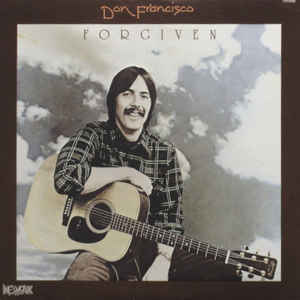
His second album, Forgiven, had a wonderful song which got a lot of initial airplay, a live resurrection day story from Peter’s perspective entitled He’s Alive, which really was better than anything he’d done already.  It climbed our charts quickly.

Then for no apparent reason, listeners turned away from it, wanting to hear a different song, the last song on the album, Adam, Where Are You?.  It was stylistically similar, focusing on the Garden of Eden and the Fall.

He released several other excellent songs, usually similar in style to these, including the title song of his next album Got to Tell Someone, and of the following album The Traveler.

All of those songs still move me, some to tears.

Don continued to record and sing for years; he released a live concert album in 2016.  I never heard anything else from him, though, as I was no longer connected to the CCM scene.

*****

The series to this point has included:

  1. #232:  Larry Norman, Visitor;
  2. #234:  Flip Sides of Ralph Carmichael;
  3. #236:  Reign of the Imperials;
  4. #238:  Love Song by Love Song.
  5. #240:  Should Have Been a Friend of Paul Clark.
  6. #242:  Disciple Andraé Crouch.
  7. #244: Missed The Archers.
  8. #246: The Secular Radio Hits.
  9. #248:  The Hawkins Family.
  10. #250:  Original Worship Leader Ted Sandquist.
  11. #252:  Petra Means Rock.
  12. #254:  Miscellaneous Early Christian Bands.
  13. #256:  Harry Thomas’ Creations Come Alive.
  14. #258:  British Invaders Malcolm and Alwyn.
  15. #260:  Lamb and Jews for Jesus.
  16. #262: First Lady Honeytree of Jesus Music.
  17. #264:  How About Danny Taylor.
  18. #266:  Minstrel Barry McGuire.
  19. #268:  Voice of the Second Chapter of Acts.
  20. #272:  To the Bride Live.
  21. #276:  Best Guitarist Phil Keaggy.
  22. #281:  Keith Green Launching.
  23. #283:  Keith Green Crashing.
  24. #286:  Blind Seer Ken Medema.
  25. #288:  Prophets Daniel Amos.
  26. #290:  James the Other Ward.
  27. #292:  Rising Resurrection Band.
  28. #294:  Servant’s Waters.
  29. #296:  Found Free Lost.
  30. #299:  Praise for Dallas Holm.
  31. #302:  Might Be Truth and the Cleverly-named Re’Generation.
  32. #304:  Accidental Amy Grant.
  33. #312:  Produced by Christian and Bannister.

#314: The Song “Walkin’ In the Woods”

This is mark Joseph “young” blog entry #314, on the subject of The Song “Walkin’ In the Woods”.

My wife and I collaborated with Bob Weston on two songs, both of them extraordinary.  The first, Holocaust, was already posted (links below); this was the second.  I listed it as my number five favorite song (music and lyrics) and the number six best recording (performance and technical); Tristan included it in his “tied for fifth” list.  It is about how churches confuse the simple gospel message, under the title:

Walkin’ In the Woods.

Although Collision: started working on a three-voice version of this when Sara joined, it never reached the point of performance ready.  There is a discussion of how it came to be written there; the line about “read the big book” was discussed, and we passed up “good book” in favor of the image of the large bibles on lecturns in many churches.  This recording was done with the Digital Orchestra program, all the instruments midis, the vocals mine.  The complex interaction of the vocals was always part of the song from the day it was written; TerraNova performed it, and the lyrics are:

Walkin’ in the woods in the middle of the night,
Try’n’ to find my way back home;
Wishin’ that I had just a little bit of light,
Try’n’ to find my way, get it right, get it right.
Runnin’ into people, say they’ll show me the way,
Take me to the edge of the pit and walk away.

Don’t walk away from me,
Don’t leave me standin’ here all alone!

This one tells me how to look and what I ought to say,
That one tells me what to eat and when to pray,
This one tells me only what I should not ever do.
Who is going to tell me what is true?  What is true!?
Searchin’ for the truth, and all I find is more lies.
Shepherd, are you try’n’ to pull the wool over my eyes?

Don’t tell me how I gotta dress for your show!
Don’t tell me how I gotta look if I go!
Just tell me what I gotta know!

Walkin’ in the woods in the middle of the night,
  (I’m try’n’ to find my way back home)
Try’n’ to find my way back home;
Wishin’ that I had just a little bit of light,
  (I feel I’m really all alone)
Try’n’ to find my way, get it right, get it right.
Walkin’ in the woods in the middle of the night,
  (I’m try’n’ to find my way back home)
Try’n’ to find my way back home;
Wishin’ that I had just a little bit of light,
  (I feel I’m really all alone)
Try’n’ to find my way, get it right, get it right.

Who can tell the shepherds from the wolves?
  (You gotta have a program.)
Who can tell the shepherds from the sheep?
  (You gotta take a close look.)
Who can tell the shepherds what to do?
  (But are they list’ning?)
Who can tell the shepherds are asleep?
  (You gotta read the big book.)

Woe to the shepherds who are destroying and scattering
(Walkin’ in the woods in the middle of the night,)
sheep of my pasture, declares the Lord.
(Try’n’ to find my way back home;)
Therefore, thus says the Lord God of Israel
(Wishin’ that I had just a little bit of light,)
concerning the shepherds who are tending my people:  You have
(Try’n’ to find my way, get it right, get it right.)
scattered my flock, and driven them away,
(Walkin’ in the woods in the middle of the night,)
and have not attended to them.  Therefore, I am about
(Try’n’ to find my way back home;)
to attend to you for the evil of your deeds,
(Wishin’ that I had just a little bit of light,)
declares the Lord.
(Try’n’ to find my way,) get it right, get it right.

Walkin’ in the woods in the middle of the night,
  (I’m try’n’ to find my way back home)
    {Don’t walk away from me}
Try’n’ to find my way back home;
    {Don’t leave me standin’ here all alone,}
Wishin’ that I had just a little bit of light,
  (I feel I’m really all alone)
Try’n’ to find my way, get it right, get it right.
  {Don’t walk away from me}
Walkin’ in the woods in the middle of the night,
  (I’m try’n’ to find my way back home)
    {Don’t leave me standin’ here all alone,}
Try’n’ to find my way back home;
  {Don’t walk away from me}
Wishin’ that I had just a little bit of light,
  (I feel I’m really all alone)
    {Don’t leave me standin’ here all alone,}
Try’n’ to find my way, get it right, get it right.
  {Don’t walk away from me}

I’m lost and need to find the way.

Walkin’ in the woods in the middle of the night.

I can only hope you benefit from the song in some way.  I will continue with additional songs in the future.

*****

Previous web log song posts:

#301:  The Song “Holocaust” | #307:  The Song “Time Bomb” | #311:  The Song “Passing Through the Portal”

Next song:  That’s When I’ll Believe

#313: Verser Solutions

This is mark Joseph “young” blog entry #313, on the subject of Verser Solutions.

With permission of Valdron Inc I have previously completed publishing my first four novels, Verse Three, Chapter One:  The First Multiverser Novel, Old Verses New, For Better or Verse, and Spy Verses,  in serialized form on the web (those links will take you to the table of contents for each book).  Along with each book there was also a series of web log posts looking at the writing process, the decisions and choices that delivered the final product; those posts are indexed with the chapters in the tables of contents pages.  Now as I have posted the fifth, Garden of Versers,  I am again offering a set of “behind the writings” insights.  This “behind the writings” look may contain spoilers because it sometimes talks about my expectations for the futures of the characters and stories–although it sometimes raises ideas that were never pursued, as being written partially concurrently with the story it sometimes discusses where I thought it was headed.  You might want to read the referenced chapters before reading this look at them.  Links below (the section headings) will take you to the specific individual chapters being discussed, and there are (or will soon be) links on those pages to bring you back hopefully to the same point here.

There is also a section of the site, Multiverser Novel Support Pages, in which I have begun to place materials related to the novels beginning with character papers for the major characters, giving them at different stages as they move through the books.

This is the tenth mark Joseph “young” web log post covering this book, covering chapters 109 through 120.  Previous web log posts covering this book include:

History of the series, including the reason it started, the origins of character names and details, and many of the ideas, are in those earlier posts, and won’t be repeated here.

Chapter 109, Hastings 167

At this point my brain was writing the chapters faster than I could manage to type them, and I was concerned about forgetting important bits.  When I would turn my mind to this chapter, I found myself thinking through the next one.

I had previously mentioned that Lauren healed people of injury and disease, and added the skills to my working character paper, but had never suggested how she did this beyond that it was magic.  At this point I needed to give her a healing spell that would cure wounds entirely by speech.  I spent a bit of time thumbing through my New Testament, and found two verses that would work, which was good because I needed two rituals, one for injury and the other for disease; I needed the injury one now.  I liked Acts 4:29f, because it spoke of adversaries.  I Peter 2:24 was better for the spell overall, but was also better for the disease cure, so I went with the Acts passage.


Chapter 110, Slade 152

I kept playing this scene from different viewpoints–first as Derek’s scene, but I realized that once he was out of the room I would need another chapter for him; then as Joe’s scene, but I had shifted the previous scene to Joe.  Bob was the only one left, but it worked as his scene, as he was ostensibly leading this raid.

The hardest part here was getting everything into it that needed to be there.  Ultimately, Derek had to jump out the window with the Princess, but everything before that had to happen without feeling rushed.  The landing and the battle in the room would both be delayed.


Chapter 111, Beam 31

It occurred to me that it wouldn’t really be credible for Beam simply to walk out of the bunker, particularly given that Kondor and Slade had needed a code to open the door of a different high tech bunker in the previous book.  I thus decided I had to have him face the locked door, and find yet another way for him to open it.

Kyler had suggested that Turbirb’durpa could psychokinetically force open the doors, and that he did so on the original space station; it had not been clear to me that he had done that, but that was more power than I wanted Bob to have at this point, so I decided he must have opened those doors by reading the codes in the minds of people who knew them and telekinetically pushing the buttons.  There being no people around, he could not do that here.

I thought of triggering the fire alarm as the way to get the door open, but decided there wouldn’t be familiar fire boxes on the walls.  I then thought of setting off the smoke detectors, but I needed a reason for Beam to think of that, so I had him light a cigarette.  I also decided that a cigarette would not be enough to trigger the alarm, because they were using gunpowder weapons which while producing relatively little smoke by comparison with early versions still produced some.  However, I had let Dawn load an undefined collection of objects including grenades, and figured that she would have smoke grenades in the batch; I also decided that the smoke grenades would be flash-bangs.


Chapter 112, Hastings 168

I had envisioned Lauren hearing the news over the radio, but I also wanted to work in the part about wanting a drink, and once I had the guards talking it was natural that they would talk about the events of the day, which neither of them witnessed (one on duty, the other sleeping).  I had debated whether the part with the pipe would be part of this chapter or another, and decided that it would have to be this chapter.


Chapter 113, Brown 177

I had been thinking for a while that I had to replace Princess with something more appropriate.  I discussed it with Kyler, noting that Calipha was technically the wife of a Caliph, but that the next rank down was Amir/Amira.  I could have pushed the Caliph to Shah, but then I wanted him to be impressed by the fact that Slade was allied to the Caliph of the West Wind, and I couldn’t change that.  At this point, I committed to making her Calipha, calling the gang Caliphae but recognizing that they were technically all Amirae.

In my musings about this chapter I recognized the problems with Derek’s descent, and used the opening paragraphs to focus them in my own mind as he recognized them himself.  I also worked out how he would solve them, putting together the pieces much as they appear in the chapter.


Chapter 114, Beam 32

I was running out of outlined chapters in which to accomplish everything, and not certain I was not going to tighten the whole thing, but I couldn’t not have Beam teach the others how to shoot.  I also needed to work out how the rail gun worked, which evolved in my mind through several stages before I put the batteries in the clips.


Chapter 115, Hastings 169

I thought this would be longer, but it did enough.  I wanted her to suggest to the jailer that God had provided the water, and that she was now asking for food, which He might somehow provide if the jailer didn’t.  I don’t know whether there’s going to be food for her.


Chapter 116, Beam 33

When I reached this point in the Beam story, I had finished everything else and created an outline which left me four chapters to finish his story.  I decided that probably was not enough, so I moved what was going to be 117 Beam 32 up to 116 Beam 32, pushing 116 Kondor 153 down to 117 Kondor 153, and expecting to put in more Beam chapters from there.  This was good, in part because I had 122 chapters in my outline and recognized that this was not going to divide well into sections for online publication (being 2*61, both prime numbers), so changing that number would be an added benefit.

I used something I learned from watching Ed Jones run games:  I didn’t need to know how many beasts were attacking, I only had to have them run out when the party had become vulnerable.

I wanted the cliffhanger here, even though I knew what happened next.


Chapter 117, Kondor 153

I had known for quite a while that the Amir was going to be shot, and had concluded that it would be Zeke who pulled the trigger.  Some of that had come into focus in my mind, but the part about how to get the people from there to the palace was still a bit weak, and was pasted together as I wrote it.

I also wanted to avoid having a chapter in which Slade reported the events of the raid, so I separated him from the group at this point.


Chapter 118, Beam 34

I was inserting chapters and renumbering to make room for a longer Beam story than anticipated, bumping everything.

The resolution of the wolf attack was written immediately after the attack itself, but I wanted the cliffhanger, and I wanted the resolution to go directly in to the crying scene, although it was late so I postponed writing the crying scene and went to bed instead.  I think I got what I wanted from it.


Chapter 119, Hastings 170

I was going to do this as a beheading on a chopping block, but the guillotine was an abrupt decision.  It was a better choice.

The joke about the engineer probably doesn’t work.


Chapter 120, Beam 35

I was still accelerating the Beam story to finish it against the others.  I needed them to recover the property that was not at the wedding, and wanted Bron to have some blacksmithing tools; besides, I had not had the Pyronics at the wedding and didn’t think there was any logical reason for it to be there despite the fact that Beam had nearly everything else he owned with him there.

I had realized that the hammer would provide a beacon back to the bunker almost as soon as I put it there, but I wasn’t completely certain I was going to use it.  I had tinkered with the idea that the power supplies in the crawlers could be tapped to charge weapons, but decided that would make the Pyronics too easy to use.

I had also already decided that the way to keep Beam’s equipment within weight limits was to give the food to Sophia and the Pyronics to Bob, neither of whom are anywhere near their weight limits otherwise.  Beam’s party is equipment-heavy, so they have to share the load, and since they don’t know that they have limits on what will go with them, they have to do so for reasons that make sense within their situations and knowledge.


This has been the tenth behind the writings look at Garden of Versers.  If there is interest and continued support from readers we will endeavor to continue publishing the novel and these behind the writings posts for it.

#312: Produced by Christian and Bannister

This is mark Joseph “young” blog entry #312, on the subject of Produced by Christian and Bannister.

This duo has been mentioned already in our series.  Chris Christian and Brown Bannister both had their own albums, and they never sang together–but they did everything else together, and had a major impact in the early days of the Contemporary Christian Music world.  That’s a more recent image, with Brown on the left and Chris on the right; despite the amount of work they did together, there seem to be no online photos from their early days (I remember seeing one on someone’s album cover, but with the amount of work they did I’m not about to try to search all the album covers).

Chris is one of those miracle breakthrough artists.  He wrote a song when in high school, and went to Nashville where he sold it to Elvis Presley.  I don’t recall what song it was–having started my boyhood interest in rock music with The Beatles I never had much of a positive attitude toward Elvis, who was already “old” music to me.  That put Chris on the inside in the music industry, so he knew people.

He heard a band called Dogwood, and thought he could produce a good album with them, so he called Pat Boone at Word in Texas and said he thought he could do it for five thousand dollars.  Pat asked if they were any good and if he thought he could do this, and he said yes, so Pat sent him the five thousand dollars and he produced the album.  It was successful; they had a folk rock sound comparable to Crosby, Stills, and Nash, and that was popular at the time.

At some point he persuaded his friend Brown to move to Nashville, and was finding work for him.  Then he said he had an idea, and Brown needed to go learn to be a recording engineer.

Meanwhile, back in Waco B. J. Thomas contacted Word Records about doing a Christian album, and someone out there said he knew just the guy to produce it.  Brown had been learning to be a recording engineer for all of three weeks when Chris called him and said come, we’re producing B. J. Thomas.  Home Where I Belong was a huge success in the Christian music world, and gave Chris the contract through which he produced The Imperials and discovered Amy Grant and soon was producing pretty much any Christian artist who was located in the east but released through Texas.

That is what they did, and they did it well.

Over the course of a couple decades Chris released a score of albums of his own; Brown released one, Talk to One Another, which somehow I either completely missed or completely forgot even though it was released in 1981.  His work was almost always behind the scenes.  Even when I met them at one of Chris’ concerts, Chris was the talker.  He joked on stage that people would ask if “Chris Christian” was his real name, and he would say no, his name was “Wally Witness” but he thought that that was too much so he took a stage name.  However, his real name was Lon Christian Smith; Chris Christian was a professional nom de plume.

Chris always objected to the concept of “Christian instrumental music”.  What made a song Christian or not, he asserted, was the words.  In his early concerts he would illustrate this by sitting at the piano and playing Alley Cat, and every time the music paused he would insert a different “Christian” word–“Jesus”, “God”, “Holy Spirit” and the like.  The joke of course was that if you put Christian words in the breaks, Alley Cat becomes a Christian song, but without the words it’s just music.

His 1976 self-titled debut album included his version of his song Mountaintop, later popularized by Amy Grant when he produced her debut.  Christian music still being sparse, his 1977 LP Chance had several tracks that were notable at the time, including Satisfaction Guaranteed, From the Start (usually played without the dramatic intro) which B. J. Thomas also recorded, the title song Second Chance, and his country-jugband influenced version of The Imperials hit he had produced, Sail On.

His 1979 With Your Love had a couple of songs already popularized by The Imperials including Praise the Lord and (not found online) Heed the Call.

1981 saw two albums, Just Sit Back and a reportedly rockier second self-titled LP, neither of which I recall; nor do I remember his 1983 Love Them While We Can or 1984 Let the Music Start.  By this time Chris, along with Brown, was much more important for the work of others, such as White Heart.  He continued making albums for the rest of the century, none of which I ever heard, but he also continued producing the work of others in the field, and doing an excellent job of it.

*****

The series to this point has included:

  1. #232:  Larry Norman, Visitor;
  2. #234:  Flip Sides of Ralph Carmichael;
  3. #236:  Reign of the Imperials;
  4. #238:  Love Song by Love Song.
  5. #240:  Should Have Been a Friend of Paul Clark.
  6. #242:  Disciple Andraé Crouch.
  7. #244: Missed The Archers.
  8. #246: The Secular Radio Hits.
  9. #248:  The Hawkins Family.
  10. #250:  Original Worship Leader Ted Sandquist.
  11. #252:  Petra Means Rock.
  12. #254:  Miscellaneous Early Christian Bands.
  13. #256:  Harry Thomas’ Creations Come Alive.
  14. #258:  British Invaders Malcolm and Alwyn.
  15. #260:  Lamb and Jews for Jesus.
  16. #262: First Lady Honeytree of Jesus Music.
  17. #264:  How About Danny Taylor.
  18. #266:  Minstrel Barry McGuire.
  19. #268:  Voice of the Second Chapter of Acts.
  20. #272:  To the Bride Live.
  21. #276:  Best Guitarist Phil Keaggy.
  22. #281:  Keith Green Launching.
  23. #283:  Keith Green Crashing.
  24. #286:  Blind Seer Ken Medema.
  25. #288:  Prophets Daniel Amos.
  26. #290:  James the Other Ward.
  27. #292:  Rising Resurrection Band.
  28. #294:  Servant’s Waters.
  29. #296:  Found Free Lost.
  30. #299:  Praise for Dallas Holm.
  31. #302:  Might Be Truth and the Cleverly-named Re’Generation.
  32. #304:  Accidental Amy Grant.

#311: The Song “Passing Through the Portal”

This is mark Joseph “young” blog entry #311, on the subject of The Song “Passing Through the Portal”.

Two months back I started publishing my songs through web log posts; links to the first two such posts which include an explanation of the process are at the bottom of the page.  Some of what I explain here will only make sense if you’ve already seen those posts.

This song was ranked only number nine on my list of “best songs”, and Tristan had it on his list tied for fifth.  However, it was always ranked as the best performance/recording of all those available–and it’s difficult to argue against that.  Nick Rhoades’ drumming is phenomenal, Eric Kyle Baxter captured the lead guitar work brilliantly, Jonathan Manness managed the keyboards and hit the backup vocals spot on, which means the only person about whom I might complain is that lead vocalist/bass guitarist, which is me, so I’m not going to complain.  The average made it number three, and so the third of the three songs sent to The Objective Session people.  It is entitled

Passing Through the Portal.

The song was included in the Collision:  Of Worlds album, and so I wrote about it before, including the humorous way it came to be written.  It was the fan favorite at concerts despite the fact that some older listeners thought it a bit nostalgic in style.  It also was the inspiration for Faith in Play #2:  Portals at the Christian Gamers Guild.  This recording is the one from the album, engineered by Tony Mascara of Millville, New Jersey, in his basement studio, and the lyrics are:

Passing through the portal–

Leavin’ this wicked old world behind,
Changin’ my heart, renewing my mind.
Oh, and did I fail to mention
I’m travelin’ to a new dimension?
Passing through the portal to the new world.

Crossin’ the bridge, the bridge is a cross;
All that was gained I’ve counted as loss.
No, it’s not my imagination–
I’m movin’ into the new creation.
Passing through the portal to the new world.

I’ve come to say goodbye–
You needn’t ask me why.
I’ve turned my eye to the new world,
To the new world.

Passing through the portal–
I become immortal–
Passing through the portal to the new world

I can only hope you benefit from the song in some way.  I will continue with additional songs in the future.

*****

Previous web log song posts:

#301:  The Song “Holocaust” | #307:  The Song “Time Bomb”

Next song:  Walkin’ In the Woods

#310: Versers Mobilize

This is mark Joseph “young” blog entry #310, on the subject of Versers Mobilize.

With permission of Valdron Inc I have previously completed publishing my first four novels, Verse Three, Chapter One:  The First Multiverser Novel, Old Verses New, For Better or Verse, and Spy Verses,  in serialized form on the web (those links will take you to the table of contents for each book).  Along with each book there was also a series of web log posts looking at the writing process, the decisions and choices that delivered the final product; those posts are indexed with the chapters in the tables of contents pages.  Now as I have posted the fifth, Garden of Versers,  I am again offering a set of “behind the writings” insights.  This “behind the writings” look may contain spoilers because it sometimes talks about my expectations for the futures of the characters and stories–although it sometimes raises ideas that were never pursued, as being written partially concurrently with the story it sometimes discusses where I thought it was headed.  You might want to read the referenced chapters before reading this look at them.  Links below (the section headings) will take you to the specific individual chapters being discussed, and there are (or will soon be) links on those pages to bring you back hopefully to the same point here.

There is also a section of the site, Multiverser Novel Support Pages, in which I have begun to place materials related to the novels beginning with character papers for the major characters, giving them at different stages as they move through the books.

This is the ninth mark Joseph “young” web log post covering this book, covering chapters 97 through 108.  Previous web log posts covering this book include:

History of the series, including the reason it started, the origins of character names and details, and many of the ideas, are in those earlier posts, and won’t be repeated here.

Chapter 97, Hastings 163

I spent a good day trying to wrap my head around this chapter, and then sat down and typed the first line–and the neighborhood power went out for most of an hour.  I didn’t get back to it until early the next morning, when I was squeezing in a few minutes before rushing out the door, so it was a bit rushed in the original draft.


Chapter 98, Kondor 151

I felt this had to be a Kondor chapter, but realized that he wasn’t going to be the inquisitor, and that meant the action would be mostly Slade, some Derek.  It took me a bit of thinking to wrap my head around how to do that.

I had also been thinking at the same time about how Slade would plan to penetrate the manor, and so I was ready with that when it was time.


Chapter 99, Beam 27

I decided on sleep next; I had several things I wanted to accomplish, but I needed the party to sleep while they still felt safe, so that was now.  I’m also trying to figure out how Beam’s relationship with Sophia is going to go.  At the moment she doesn’t much like him and he doesn’t much care, but that has to change because for a future story I need her to be very possessive of him.


Chapter 100, Hastings 164

I had decided on a lot of parts related to Lauren’s martyrdom, but I suddenly realized I had not decided whether there would be a trial, or what it would be like.


Chapter 101, Slade 151

I made an interesting observation while watching something on television (I think it was a movie, but I’m not certain now).  If in the script someone tells you the plan, it’s going to go awry; if the plan is going to work smoothly, the viewer isn’t given the details in advance.  I wasn’t entirely certain of all the details of the plan, and I had already thought that it was going to go wrong, but decided that it was better not to attempt to tell too much of what was supposed to happen.


Chapter 102, Beam 28

I needed the combat, and was looking for where to put it.  This seemed the best spot.  I gave some thought to the infiltrator.  It needed to be small enough to be credible as something that entered through small portals, but large enough to be a credible threat.

I was starting to worry about whether I could rearm the party soon enough at this point, and indeed whether the reader would think Dawn ought to be out of bullets by now.  I never said anything about how many bullets they had for either gun, but figured I have them in a place where they can get more, and that will be my next stop.

I also confess that I had a slight oversight.  When Dawn was introduced it was said that she had three guns visible, and Beam suspected she was also carrying other weapons, and he had his own revolver.  He swapped guns with her, at least briefly, but at some point apparently swapped them back.  However, thereafter the group was treated as if there were only the two guns, Dawn’s .44 pistol and Beam’s .45 revolver.  By the time I recognized the discrepancy I had already written the chapter in which they find the armory and better arm themselves, and in the interim there were few enough encounters that the oversight might be a matter of how scenes were described–that Dawn has extra guns doesn’t matter if she never uses them, and no combat lasted long enough for her to need another gun.


Chapter 103, Hastings 165

I had debated whether to have this trial, but when it struck me that I could make a mockery of their justice system by turning the trial into essentially a rubber stamp on the prosecutor’s case, I went with it.


Chapter 104, Brown 176

I had envisioned this covering considerably more of the rescue, which would have been bad for a climactic scene, but I had decided that the Amir would assign guards to them at the door, and it was a small and abrupt step to decide that he would invite the regular guards to wait there, separating Joe and Zeke from the others.  I needed Joe and Zeke on the rescue, so it gave me more story as Derek and Slade would have to eliminate the guards and then rescue Joe and Zeke before continuing.


Chapter 105, Beam 29

It was important to me that Beam get some high tech weapons for the next world, and that he replenish the ammo for the ones he had.  On the other hand, he wasn’t going to open a door and find it; I needed to make it make sense.  Thus he comes to a locked armored door, and it’s obvious that this must be the armory, but he has to figure out how to get through it.  I already knew the solution, but I needed him to face the problem, and thus I made this a cliffhanger.


Chapter 106, Hastings 166

Originally I was going to continue the scene in this chapter, but I decided I wanted the cliffhanger ending and I wanted more chapters in this part of the story.  I also wrote more at the beginning than I’d anticipated, so I put the break at the tense moment and went to the other story.


Chapter 107, Kondor 152

I kept changing my mind about who told which parts of the story.  Derek was going to be doing most of the work, because his was the only non-lethal attack, but I didn’t really want it to be all from Derek’s perspective, and I didn’t want to keep repeating how he disabled each guard.  There were enough of them, and unless something went wrong it would be pretty much the same.


Chapter 108, Beam 30

I discussed what kind of weapon Sophia might be able to use with Kyler, and he suggested several, of which the taser and the small rail gun seemed the most practical.  I had had a shotgun in mind for Bron for quite some time, and knew that Dawn would go for a military rifle with grenade launcher.

I also wanted to give him a way to carry everything, but decided with all the food he was going to need two.  I have not yet figured out how to get these into the weight limits of the characters, but that’s not yet a problem.


This has been the ninth behind the writings look at Garden of Versers.  If there is interest and continued support from readers we will endeavor to continue publishing the novel and these behind the writings posts for it.

#309: Racially Discriminatory Ticketing

This is mark Joseph “young” blog entry #309, on the subject of Racially Discriminatory Ticketing.

A music festival in Detroit aimed at a black audience openly advertised that tickets for white people (“non-persons-of-color”) would cost twice what the same tickets would cost for “persons of color”.  This clearly racially discriminatory policy had a justification, which we will address, but the justification was just as discriminatory.

Praise goes to Jillian Graham, who goes by the stage name Tiny Jag, a rapper who withdrew from the concert when she learned of this discriminatory policy, and informed her fans concerning the reason for her withdrawal.  Prejudice is just as ugly when reversed, and this was a case of reverse discrimination.

Afrofuture Youth, Detroit-based sponsors of Afrofuture Fest, explained their policy:

OUR TICKET STRUCTURE WAS BUILT TO INSURE (sic) THAT THE MOST MARGINALIZED COMMUNITIES (PEOPLE OF COLOR) ARE PROVIDED WITH AN EQUITABLE CHANCE AT ENJOYING EVENTS IN THEIR OWN COMMUNITY(BLACK DETROIT).

AFFORDING JOY AND PLEASURE IS UNFORTUNATELY STILL A PRIVILEGE IN OUR SOCIETY FOR POC AND WE BELIEVE EVERYONE SHOULD HAVE ACCESS TO RECEIVING SUCH.

WE’VE SEEN TOO MANY TIMES ORGASMIC EVENTS HAPPENING IN DETROIT AND OTHER POC POPULATED CITIES AND WHAT CONSISTENTLY HAPPENS IS PEOPLE OUTSIDE OF THE COMMUNITY BENEFITING MOST FROM AFFORDABLE TICKET PRICES BECAUSE OF THEIR PROXIMITY TO WEALTH.

THIS CYCLE DISPROPORTIONATELY DISPLACES BLACK AND BROWN PEOPLE FROM ENJOYING ENTERTAINMENT IN THEIR OWN COMMUNITIES.

The prejudice is obvious here:  Afrofest attaches wealth absolutely to color, that all white people are wealthy and all non-white people are impoverished.  That’s not only not how it works, that’s a set of stereotypes damaging to everyone.

I can assure you that Thomas Sowell, Justice Thomas, Barrack Obama, and Beyoncé Knowles are all “persons of color” and all have considerably more money than I have.  I suspect that at least some of them have more money than most of my readers, black, white, or other.  Were I better versed in people I could probably list hundreds of “persons of color” who are among the wealthy, from entertainment, sports, business, politics, medicine, and law.  But I suspect the reverse is similarly true.  AfroFuture wants to serve the poor of Detroit, but mistakenly assumes that there are no poor white people in the city.  Certainly the deep metropolitan areas of Detroit are predominantly black–but demographic statistics shows a not-negligible caucasion contingent.  Do they live in the wealthy Detroit neighborhoods?  I think there are no more of those.

AfroFest’s goals of ensuring access to entertainment for the impoverished in Detroit are admirable; their methodology is deplorable.

They could have achieved much the same goal by selling discounted tickets not to people of color, but to people with proof of residency:  create a set of tickets for Detroit residents, possibly including immediate suburbs similarly blighted, and require that anyone over a certain age presenting such a ticket at the gate also present proof of address.  That way people from the impoverished neighborhoods get the discount without reference to whether they happen to be black or hispanic or Asian or poor whites.  That would be a considerably less prejudicial way of discriminating, that is, of catering to poor people and making wealthier people pay more, instead of selling cheap tickets to wealthy blacks and making poor whites pay extra for theirs.

Of course, if AfroFest is correct that there are no wealthy blacks or poor whites in the Greater Detroit metropolitan area, they get the same result–and they don’t have to use racial profiling to do so.