All posts by M.J.

469: Church History

This is mark Joseph “young” blog entry #469, on the subject of Church History.

This title is overblown.  About fifteen years ago I did a twenty-three part series at the Christian Gamers Guild Chaplain’s Bible Study about Church History, which at the time I thoroughly researched and still had to be corrected on a few points, and I’m not doing that research again now and not even re-reading that series.  But I was asked a question, and I’m going to attempt to muddle through an answer which I hope is adequate.

The questioner asks me such questions periodically, and sometimes I address them on Facebook, but when they get complicated I resort to writing posts for this weblog.  This time the question reads:

I’m confused so I turn to you for enlightenment.  Even when I was Protestant I had no idea between charismatics and Pentecostals and Calvinists.  They seem to fight a lot according to these so called faith based preachers that are on my video feed.  I enjoy listening to them for purely entertainment purposes because frankly, they tell me nothing other than their dislike for the other.  Maybe you could shed some light.

For background, the questioner was raised Lutheran, attended a Lutheran Bible college briefly and became serious about Christian faith when he played in a Christian band.  He converted to Roman Catholicism to accommodate his second wife, and has studied the beliefs of that church more intently than he had studied Protestantism generally or Lutheranism specifically.  Most of that is outside the parameters of the question anyway, but it might help the reader to understand my starting point.

It probably isn’t much use to understand the origins of the Reformation, but I find it at least interesting.  We actually start in England with Wycliff, who put forward the idea that ordinary people should have access to the text of the Bible in their own language.  The Catholic Church opposed this concept, because it was felt that uneducated people reading the Bible in versions that were not the original text or Latin translations rendered by persons who had been identified as “Saints” would get wrong ideas and teach them to others–and there was by this time a long history of heresies started by reasonably educated and scholarly people who read the Bible and got wrong ideas from it, so there was some reason for concern.  Wycliff was far enough from Rome to survive scrutiny, and his message managed to reach a man in Czechoslovakia named Hus.  He wrote a few things that the church didn’t particularly like, but he didn’t actually cross any lines, and his teachings were preserved within the monastic orders for consideration.  They thus reached a young monk named Martin Luther, who found them enlightening and realized that there were some problems with what the church was teaching and doing at that time, so he wrote a list of problems he thought the church should discuss, his ninety-five theses.  He posted a copy on the front door of his church in Germany, as announcements of local interest were generally promulgated, and mailed copies to a few friends around Europe.  One of those friends had access to a Gutenberg moveable type printing press, untested technology at the time, and made many copies of this, which then flooded Europe, and what was supposed to be a starting point for discussion became a battle line for division.

I believe that everyone is wrong about something, including me; a major point of study is to identify my own errors and correct them, which I have done repeatedly over the decades as I refine my understanding of what scripture actually teaches.  A corollary to that is every denomination holds a fundamental error in its doctrine, and this appears at the Reformation.

Whether or not it was official, the perceived message of the Catholic Church was that to get into heaven you had to be sinlessly perfect.  To achieve sinless perfection, you had to be forgiven, and divine forgiveness was mediated through the church.  Thus you confessed your sins to priests who gave you absolution, and usually prescribed penance–good deeds you should do to earn that forgiveness.  Probably that would have been stated as demonstrating that you deserve it, but it’s not very different in concept.  Because of this Last Rites are extremely important, because before you die you must confess all the sins you undoubtedly committed since your last confession, or you will have to pay for them in Purgatory or even go to Hell.  This led to abuses–if the church mediates forgiveness, you can be given forgiveness for wrongs you have not yet committed, and thus the sale of indulgences had become popular, the church prospectively forgiving sins you planned to commit in exchange for substantial gifts you gave to the church.

Luther rejected these ideas.  Forgiveness, he argued, was not earned but given freely, paid for by the sacrifice of Jesus.  It was given to everyone who had faith, and the church had no control over that.  Calvin agreed with this–but then they had a problem.  They were determined that in their understanding Christianity was never about doing something to earn your salvation–works–but entirely about faith, but it struck them that if you had to choose to have faith, then faith was something you did, and therefore a work, and they were back where they started with using faith to earn salvation, something that was a gift and could not be earned.  They each resolved this in a different way.

As an aside, I think this is where the Reformers made their error.  Later denominations have argued in essence that faith, a choice, is not a work, an act, and thus you can choose to trust God and so be saved without that counting as a good work that you did.  Strict Reformation Christians criticize this as “Decision Theology”, that you get to choose whether to believe, because the solution to the faith-is-works problem that the Reformers gave is that you don’t choose to believe, God chooses to give you faith, to cause you to believe.  In support of this, Ephesians 2:8f is frequently cited, reading (in the American Standard Version) for by grace have ye been saved through faith; and that not of yourselves, it is the gift of God; not of works, that no man should glory.  The error here is thinking that the “that” refers to the faith, but “that” is neuter and needs a neuter referent, and both “faith” and “grace” are feminine, so the “gift”, which is neuter, has to be the focus of the statement, the salvation which is given by grace and received through faith.

However, working from the assumption that faith had to be a gift, Calvin deduced, logically, that God decided who would and would not be saved, entirely arbitrarily, and individuals had no choice in the matter–either God saved you, or he didn’t.  This gives us the “Five Points of Calvinism”, which in English are recalled by the mnemonic “TULIP”:

  1. Total Depravity, that people are too corrupt ever to be able to do anything genuinely good on their own;
  2. Unconditional Election, that God makes his choice without reference to anything about us;
  3. Limited Atonement, that Jesus didn’t die for everyone but only for those God chose to save;
  4. Irresistible Grace, that if you have been chosen you cannot fail to believe;
  5. Perseverance of the Saints, that those who are actually divinely chosen will persevere to the end and so be saved.

Thus Calvin’s answer was that God arbitrarily decides who will be saved, forces those people to have faith, saves them, and condemns everyone else.  This is strict Calvinism.  Luther, by contrast, resolved the matter with an irrational solution:  God offers to give everyone faith to believe, and if you accept that faith it’s no credit to you, but you can reject it, in which case you are responsible for your own damnation.

The churches which call themselves “Reformed”, “Calvinist”, or “Presbyterian” generally follow Calvin’s schema, although as I read in a booklet by Catholics explaining Presbyterianism, most members of such churches are more interested in whether they are following Jesus than whether they are following Calvin.  It is also followed by some Baptist denominations, but others follow the line of Arminius, who attempted to correct Calvinism’s strict double-predestination system (you are predestined to be saved or predestined to be lost), which led to decision theology, adopted by many Baptists and most of the Evangelical movement.  It should be noted that there are Calvinist Evangelists, whose motivations are first that evangelism is commanded and second that we don’t know whom God is going to save so we have to present the message to everyone.

So we’re almost halfway there–these are the Calvinists.  They are distinguished from earlier Catholics by the belief that salvation is entirely by grace through faith with no relation to works, and from later Evangelical denominations by the belief that people really don’t have a choice but are chosen and given faith without reference to their own feelings about the matter.

We now have to move through a few centuries and a couple of “Great Awakenings” in which new denominations such as the Baptists and the Methodists arose, to get to the end of what some call the Third Great Awakening (others object that there are only two), involving Moody and Finney.  In the wake of this there were strange events, among them healings, visions, and ecstatic speech.  The concept developed that some people went beyond being saved to being “baptized in the Holy Spirit”.  This was the foundation of the Pentecostal movement, which led to the creation of several Pentecostal denominations united by a recognition of this “second” experience and manifestations of Spirit involvement, most notably speaking in tongues.

Established denominations in which this was not a reality could not accept the notion that there was “more of God than you know”.  Whatever this new experience was, it couldn’t be of God, because the established churches all believed that there was nothing else God was doing in the world that they didn’t have.  In fact, all of them had theological explanations for why these didn’t exist–they were limited to the capital-S Saints, or they ceased at the end of the first century as the New Testament replaced them, or the references actually are to natural gifts like preaching and translation and medical skills.  The Pentecostals couldn’t be called heretics because they maintained all the essentials of orthodox docrine, but many denominations believed that the supposed supernatural manifestations of the Holy Spirit were demonic.  Pentecostalism was thus marginalized for the first half of the twentieth century.

Sometime around 1960, plus or minus a few years, small numbers of members of traditional denominations became involved with Pentecostals (probably due to the ecumenical movement) and brought concepts of Pentecostalism back to their churches.  Beginning with the Catholics, these groups were called “charismatic” from the Greek “charisma”, a gift of divine grace.  Many of these groups “received the left foot of fellowship” from their churches, but by 1970 there were established “charismatic movements” in all the major denominations (Baptists were generally the holdout), but there were also independent fellowships built on charismatic theology that were evolving into churches.  They tend to blend Pentecostal experience with more traditional church practices, peculiarly mostly the Baptist practices and beliefs, probably because the Baptists were most resistant to accepting the Charismatics as a genuine move of God.  However, there are Charismatic churches in most denominations, and Charismatic groups in many churches that are affiliated with traditional denominations.

Calvinists generally believe that Evangelicals are wrong about the ability to choose to have faith, and thus they are against Pentecostal and Charismatic beliefs because of that, but also because of a belief that all the miraculous manifestations of the Spirit are relegated to the first century.  Pentecostals and Charismatics criticize Calvinists for failure to recognize that people can choose to have faith, and for excluding the power of God from their religion.  Pentecostals criticize Charismatics for trying to “pour new wine into old wineskins”, saying that the new move of God won’t work in the old churches, and Charismatics criticize Pentecostals for throwing out the baby with the bathwater, that is, overlooking that there is much in the denominational traditions that has value and should be preserved.

All of that is a bit simplistic, and indeed there are Calvinist Pentecostals and Charismatic Calvinists.  Most Pentecostals and Charismatics are Evangelicals, but not all.  Many Pentecostals and Charismatics fellowship together.  However, as has been observed by others, the closer any two groups are to each other, the more emphasis they put on their differences.

I hope that helps.

468: The Song “Present Your Bodies”

This is mark Joseph “young” blog entry #468, on the subject of The Song “Present Your Bodies”.

Identifying when I wrote this song is a bit tricky, but I have a few clues.

In May or June of 1975, shortly after The Last Psalm played its last concert and just before I was invited to join Jacob’s Well, I wrote a song called Walkin’; that song is slated for next month, simply by a sort of random roll, but it is relevant here, because this song is like that one in structural ways of which I was always aware–indeed, I think they were intentional–but which might not be obvious to the casual listener.  Unfortunately, you won’t be able to hear the other song until next month, unless of course you’ve arrived late, in which case the link to it should be at the bottom of this page.

The similarities are related to the fact that the “bridge” is marked by a significant key change which changes the feel of the music, and it is repeated such that it launches out of both the chorus and the verse.  Both songs have three verses, multiple repetitions of a chorus, and as mentioned a repeated bridge.  It was a formula that worked perhaps better for the other song than it did for this one, and I rarely sang it for that reason; it was lengthy and repetitious, and I was never certain it held the attention of the audience.  I rarely sang the other, either, but that was for different reasons to be addressed next month.

I suppose the similarities end there.  This song is considerably slower and more somber than the other, and its power comes from a slow drive and potent words.  The lyrics are entirely quoted or paraphrased from scripture in this song, while that one is more a narration of a poetic salvation message.

My other major clue is that in the summer of 1977 I was using a small studio at Gordon College to record a few songs (those tapes, alas, long lost), and this was one of them.  That gives me a window during which this was created.

This is another vocals-over-midi-instruments recording.  Again its simplicity helps support a decent recording, although there is a technical hiccough in the midi at one point.

Present Your Bodies.

So here are the lyrics.

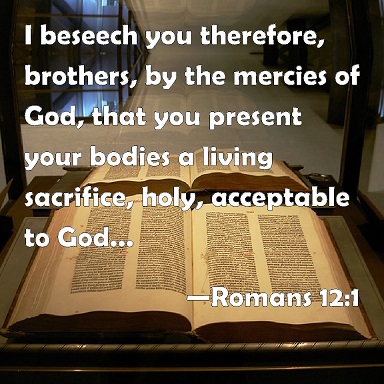
Brethren, I beseech you by the mercies of God,
Present your bodies a living sacrifice.
Set aside the sin that oh, so easily besets you.
Forget the past, and press on toward the prize.

Walk in a manner worthy of the Lord
With all humility, with gentleness,
With patience.
Always be diligent in striving to preseve your unity
In peace.

Brethren, I beseech you by the mercies of God,
Present your bodies a living sacrifice.
Set aside the sin that oh, so easily besets you.
Forget the past, and press on toward the prize.

Count it joy when you suffer for the Lord,
And thank Him that He finds you worthy
To serve Him.
He will reward those who continue praising through their suffering
For Him.

When He comes back again
He will repay
Each one according to his deeds.
When you are serving Him
Day after day,
He will provide for all your needs.

Brethren, I beseech you by the mercies of God,
Present your bodies a living sacrifice.
Set aside the sin that oh, so easily besets you.
Forget the past, and press on toward the prize.

Place your whole life solely in His hands.
He’s working all things for His glory
And our good.
He’ll finish ev’ryone in whom He has begun salvation.
Amen.

Brethren, I beseech you by the mercies of God,
Present your bodies a living sacrifice.
Set aside the sin that oh, so easily besets you.
Forget the past, and press on toward the prize.

When He comes back again
He will repay
Each one according to his deeds.
When you are serving Him
Day after day,
He will provide for all your needs.

He’ll finish ev’ryone in whom He has begun salvation.
Amen.

*****

Previous web log song posts:

#301:  The Song “Holocaust” | #307:  The Song “Time Bomb” | #311:  The Song “Passing Through the Portal” | #314:  The Song “Walkin’ In the Woods” | #317:  The Song “That’s When I’ll Believe” | #320:  The Song “Free” | #322:  The Song “Voices” | #326:  The Song “Mountain, Mountain” | #328:  The Song “Still Small Voice” | #334:  The Song “Convinced” | #337:  The Song “Selfish Love” | #340:  The Song “A Man Like Paul” | #341:  The Song “Joined Together” | #346:  The Song “If We Don’t Tell Them” | #349: The Song “I Can’t Resist You’re Love” | #353:  The Song “I Use to Think” | #356:  The Song “God Said It Is Good” | #362:  The Song “My Life to You” | #366:  The Song “Sometimes” | #372:  The Song “Heavenly Kingdom” | #378:  The Song “A Song of Joy” | #382:  The Song “Not Going to Notice” | #387:  The Song “Our God Is Good” | #393:  The Song “Why” | #399:  The Song “Look Around You” | #404:  The Song “Love’s the Only Command” | #408:  The Song “Given You My Name” | #412:  The Song “When I Think” | #414:  The Song “You Should Have Thanked Me” | #428:  The Song “To the Victor” | #433:  The Song “From Job” | #436:  The Song “Trust Him Again” | #438:  The Song “Even You” | #441:  The Song “Fork in the Road” | #442:  The Song “Call to Worship” | #445:  The Song “How Many Times” | #447:  The Song “When I Was Lonely” | #450:  The Song “Rainy Days” | #453:  The Song “Never Alone” | #455:  The Song “King of Glory” | #457:  The Song “Greater Love” | #458:  The Song “All I Need” | #462:  The Song “John Three” | #464:  The Song “The Secret” | #466:  The Song “In a Mirror Dimly”

Next song: Walkin’

465: Characters Wander

This is mark Joseph “young” blog entry #465, on the subject of Characters Wander.

With permission of Valdron Inc I have previously completed publishing my first eight Multiverser novels,

  1. Verse Three, Chapter One:  The First Multiverser Novel,
  2. Old Verses New,
  3. For Better or Verse,
  4. Spy Verses,
  5. Garden of Versers,
  6. Versers Versus Versers,
  7. Re Verse All, and
  8. In Verse Proportion,

in serialized form on the web (those links will take you to the table of contents for each book).  Along with each book there was also a series of web log posts looking at the writing process, the decisions and choices that delivered the final product; those posts are indexed with the chapters in the tables of contents pages.  Now as I am posting the ninth, Con Verse Lea,  I am again offering a set of “behind the writings” insights.  This “behind the writings” look may contain spoilers because it sometimes talks about my expectations for the futures of the characters and stories–although it sometimes raises ideas that were never pursued, as being written partially concurrently with the story it sometimes discusses where I thought it was headed.  You might want to read the referenced chapters before reading this look at them.  Links below (the section headings) will take you to the specific individual chapters being discussed, and there are (or will soon be) links on those pages to bring you back hopefully to the same point here.

This is the third post for this novel, covering chapters 35 through 51.  The first, covering chapters 1 through 17, appeared as web log post #460:  Versers Reorganize, and the second, covering chapters 18 through 34, #463:  Characters Unsettled.

There is also a section of the site, Multiverser Novel Support Pages, in which I have begun to place materials related to the novels beginning with character papers for the major characters, giving them at different stages as they move through the books.
History of the series, including the reason it started, the origins of character names and details, and many of the ideas, are in earlier posts, and won’t be repeated here.

Return to Top

Quick links to discussions in this page:
Chapter 35, Takano 68
Chapter 36, Beam 135
Chapter 37, Hastings 242
Chapter 38, Takano 69
Chapter 39, Beam 136
Chapter 40, Hastings 243
Chapter 41, Beam 137
Chapter 42, Takano 70
Chapter 43, Beam 138
Chapter 44, Hastings 244
Chapter 45, Beam 139
Chapter 46, Takano 71
Chapter 47, Beam 140
Chapter 48, Hastings 245
Chapter 49, Beam 141
Chapter 50, Takano 72
Chapter 51, Beam 142

Chapter 35, Takano 68

I needed to begin organizing the camp, and there was a lot to cover, but I didn’t want to overburden the chapter.

Return to Top


Chapter 36, Beam 135

I had thought about how Beam would be able to settle into a place for a while, and so the strategy he followed developed.  Again I am uncertain what to do with him, but I have to connect him back to the outlaws, I think.

Return to Top


Chapter 37, Hastings 242

I got to the middle of this and thought Lauren again needed to borrow a knife, and I knew that one of the team leaders had one, and knew which one, but couldn’t at that moment remember the names of the leaders.  But I had pressing errands, so I dropped the effort and saved everything.  It was over a week before I managed to return, during which time I wrote or prepped quite a few other projects but did not resolve all my issues here.  After I had written it, I realized that Lauren had a knife–it just wasn’t listed as such on her character sheet, instead being one of her “cooking utensils”, so I went back and changed the text to reflect that.

I knew that I would be bringing in the lake and the bathrooms, but wasn’t sure quite how, so this was that.

Return to Top


Chapter 38, Takano 69

I originally marked this as a Beam chapter, but wasn’t sure where he was going next.  Meanwhile, I had a lot to cover for Lauren and Tommy, so although I had to this point avoided two in a row in the same world, I decided this was a good place for that.

The bathrooms were loosely modelled on those at Camp Lebanon, but that I removed the showers and didn’t give them hot water.  The shower is very like one I saw at Philmont Scout Ranch, although I didn’t actually use it so I’m working mostly from descriptions.

Return to Top


Chapter 39, Beam 136

The rifles were a late decision, but I decided Beam would think it wise to use weapons for which he could replace the ammo.

The realization that Beam’s revolvers were .45 caliber came as I was writing.  I realized that it was possible that the .45 caliber bullets used in that world might be too long for his gun, but since they were used by the outlaw semiautomatic pistols, I concluded they would be short enough.

Return to Top


Chapter 40, Hastings 243

The lake was always in view here, and was in fact the first thing I had decided she would find.  She had lived by a lake when she learned all her camping abilities, and she was applying them in the new world.

Return to Top


Chapter 41, Beam 137

I had labeled this chapter for Tommy, but then in the time between writing chapters I had been considering what I was going to do next with Beam, and so this changed to cover him.

I had to have Beam pick up some equipment here, but it seemed reasonable for it to be here and for him to recognize the needs.

Return to Top


Chapter 42, Takano 70

I pondered the problem of what Tommy should paint on the bathroom and shower entrances to mark them, thinking of several of the ideas I include in the text, and then asked Kyler.  He suggested the Mars and Venus emblems, which of course would be completely unfamiliar to the people but recognizably different and something they could learn.

The question about the shelter was essentially filler, because I needed to extend the chapter meaningfully.

Return to Top


Chapter 43, Beam 138

I debated whether Ashleigh would take a vest, but decided against it.  She’s probably unhappy with the rifle, but pleased with the bullets, which fit her pistols.

Return to Top


Chapter 44, Hastings 244

I was getting bogged down in the details, and didn’t get as far as the spear fishing lesson, but I was not unhappy with it.

I realized early that the Mars and Venus symbols would have an astrological connection, and that this might be discomforting for Lauren, but not terribly particularly given that no none else would recognize it.

Return to Top


Chapter 45, Beam 139

I wasn’t sure how to get Beam onto a track I wanted.  I needed to get him on a ninja mission, but he was on the move such that it would be difficult for them to connect.  For the moment, I just needed to figure out what was logical for him to do.

I had learned from a Viet Nam veteran that soldiers in the field in Southeast Asia quit smoking because the locals don’t smoke and can smell soldiers who do.  That seemed a reasonable point to include here.

Return to Top


Chapter 46, Takano 71

I wasn’t sure that this wouldn’t bore my readers.  After all, Lauren was spearfishing in the beginning of Old Verses New, and I was repeating detail covered there.  But she has to teach people, and that includes Tommy.

It occurred to me when I finished that I didn’t include teaching people to clean the fish, but I figured that could come later.

Return to Top


Chapter 47, Beam 140

I had come up with a reason for the outlaws to contact Beam, and a reasonably credible way for them to find him, but it required that I keep him moving for a bit to establish some time passing.

Return to Top


Chapter 48, Hastings 245

It was probably not a good time for me to write–there were multiple distractions, and I was just a bit tired and unfocused–but I wanted to push forward a bit, and knew a bit of what had to be done.

The notion that six people were going to have to carry enough fish to feed a hundred had been bothering me, but I figured I didn’t have to show how they did it.

Return to Top


Chapter 49, Beam 141

I had written between a third and a quarter of this chapter when the power flashed and the computer crashed.  The autosave managed to restore about half of what I’d written, and I tried to recreate it, but it was after midnight and I wasn’t really focusing well–complicated by the fact that I wanted the chapter to be longer than I had thought through, and to end with something that I was going to reach too soon.

I was concerned that I not make my setting too North American, but had no idea whether there were any large game animals in Japan.  A search for “japan game animals” gave me a lot of links to video games, but I managed to refine the search (adding “hunting”) and get a short list that included brown and black bears, several game birds, something called a shika deer, and wild boar.  This isn’t actually Japan–for one thing, the territory is too big, as the entire known civilized world is part of the empire–but I had avoided deer precisely because I needed to distinguish Lauren and Tommy’s woods from Beam’s.

I was going to end this with the ninja arriving, and have the problem open the next chapter, but I decided there weren’t a lot of ways to bring him into the picture and I needed to do more to make this chapter long enough.

This was my solution to the problem of getting Beam back into action, given that he was a bit over the top for the ninjas.

Return to Top


Chapter 50, Takano 72

At this point I was trying to figure out how to cover the skills quickly without either the feeling that I was glossing over them or the sense that the story was bogging down in the details.  Thus I’m trying to cover things briefly but with enough detail to make them real.

Return to Top


Chapter 51, Beam 142

As I was reaching for a name for Ashleigh’s father it struck me that making him a gunsmith would make sense.  I had to go back to Beam 125 and change a bit of text so that Ashleigh wouldn’t seem to be denying that, but decided I didn’t need to include that there because she probably didn’t need to tell the blacksmith that her father was the gunsmith, and secrecy is part of their lifestyle.

Looking for that name, the first I came upon was Warren Buffet, and I decided I needed to drop the Buffet and come up with a more appropriate surname.  Then I decided peasants did not have surnames but were identified by other details, such as parentage or trade.  I didn’t want another Smith, and didn’t see him as a blacksmith, but it occurred to me that if he were a gunsmith he would secretly make the pistols for the outlaws, and would have a high status in the group; it made sense for the outlaw leader to be a gunsmith.

I ended this chapter somewhat abruptly because I had half decided there should be some kind of impediment at the exit.  A portcullis was what came to mind, as primitive as it is, but I wasn’t certain, so I decided that would be the point of the next chapter.

Return to Top


This has been the third behind-the-writings look at Con Verse Lea.  If there is interest and continued support from readers we will endeavor to continue with more behind-the-writings posts and another novel.


466: The Song “In a Mirror Dimly”

This is mark Joseph “young” blog entry #466, on the subject of The Song “In a Mirror Dimly”.

I remember exactly where I was when I wrote this song, and what inspired it.

I was dating Sue Adams my freshman college year, and in June, 1974, right after school was dismissed for the summer, we spent a few days at her home on Staten Island.  She lived in a duplex, and her grandparents, who had shared the other half of the building, had died that spring.  Thus I was given one of the vacant bedrooms in the otherwise empty half.  There was an old mirror, the sort that was losing its silver and so had an imperfect reflection, leaning against the wall near the bed, and I had my guitar handy when I awoke.  The mirror reminded me of the passage in I Corinthians 13, so the words of this song came to be.

I remember stretching a bit for the second verse, looking for something else that gave a weak reflection, and the storefront window was the only thing that came to me.  The third verse stepped out of the mold, but was still about something we would see that would, in a sense, reflect the image of God.

I was never overly fond of the song; it felt a bit strained to me.  However, others like it, particularly my wife.  I performed it with The Last Psalm in the 74-75 year, and so I included it in the recordings I made for Dave and Jes Oldham.

This is another vocals-over-midi-instruments recording.  It is rather good, probably because it is simple.

In a Mirror Dimly.

So here are the lyrics.

In a mirror dimly we can see His face.
He is God most holy; His image we can trace,
But oh, what an image–
It scares me to think that someday
I may see Him!  I may see Him!

In a storefront window we buy our peace.
We don’t count it sin, though we find release
From oh, such an image–
It scares me to think that someday
I may see Him!  I may see Him!

God is great, and God is good,
We thank Him ev’ry day.
He gives us life, He gives us food,
But if He came to stay
Would we let Him live with us?
Would we let Him reign?
He once died as Jesus;
Would He die again?

In a quiet sunset His glory shows,
But we haven’t learned yet, and may never know
Oh, such an image–
It scares me to think that someday
I may see Him!  I may see Him!

In a mirror dimly we can see His face.
He is God most holy; His image we can trace,
But oh, what an image–
It scares me to think that someday
I may see Him!  I may see Him
Face to face,
Face to face.

*****

Previous web log song posts:

#301:  The Song “Holocaust” | #307:  The Song “Time Bomb” | #311:  The Song “Passing Through the Portal” | #314:  The Song “Walkin’ In the Woods” | #317:  The Song “That’s When I’ll Believe” | #320:  The Song “Free” | #322:  The Song “Voices” | #326:  The Song “Mountain, Mountain” | #328:  The Song “Still Small Voice” | #334:  The Song “Convinced” | #337:  The Song “Selfish Love” | #340:  The Song “A Man Like Paul” | #341:  The Song “Joined Together” | #346:  The Song “If We Don’t Tell Them” | #349: The Song “I Can’t Resist You’re Love” | #353:  The Song “I Use to Think” | #356:  The Song “God Said It Is Good” | #362:  The Song “My Life to You” | #366:  The Song “Sometimes” | #372:  The Song “Heavenly Kingdom” | #378:  The Song “A Song of Joy” | #382:  The Song “Not Going to Notice” | #387:  The Song “Our God Is Good” | #393:  The Song “Why” | #399:  The Song “Look Around You” | #404:  The Song “Love’s the Only Command” | #408:  The Song “Given You My Name” | #412:  The Song “When I Think” | #414:  The Song “You Should Have Thanked Me” | #428:  The Song “To the Victor” | #433:  The Song “From Job” | #436:  The Song “Trust Him Again” | #438:  The Song “Even You” | #441:  The Song “Fork in the Road” | #442:  The Song “Call to Worship” | #445:  The Song “How Many Times” | #447:  The Song “When I Was Lonely” | #450:  The Song “Rainy Days” | #453:  The Song “Never Alone” | #455:  The Song “King of Glory” | #457:  The Song “Greater Love” | #458:  The Song “All I Need” | #462:  The Song “John Three” | #464:  The Song “The Secret”

Next Song: Present Your Bodies

465: Believing in Ghosts

This is mark Joseph “young” blog entry #465, on the subject of Believing in Ghosts.

In Matthew 14:26 we are told that the disciples, caught in a storm on the water, saw Jesus walking on the waves coming toward them and thought He was a ghost.  (We find the same statement in Mark 6:49.)  This raised a question:  Did they believe in ghosts?  Do we?  Should we?

I recently heard a comedienne comment that
she had figured out that ghosts were
people who died trying to fold a fitted bedsheet.

The question was raised by a long-time friend and reader who sometimes brings questions about the Bible and faith to me (notably, the question about The Abomination of Desolation).  I had recently commented in an article elsewhere that many people do believe in ghosts, and not just those who, like the cowardly lion, are faced with frightening events they don’t understand.  Our world even has professional ghost hunters who are fully persuaded that there is something real about these phenomena, and that they know what it is.

Of course, we have many who disbelieve, as well.  C. S. Lewis commented (in Miracles:  A Preliminary Study) that he knew someone who had actually seen a ghost, but that the witness did not believe in ghosts either before or after that sighting.

The Greek word in this passage is the one from which we get the word “phantasm”, and etymologically derives from a word for light to suggest something that appears, something that can be seen but has no substance.  “Ghost” is a good translation for it.  It is not used in any other passage in the New Testament, but it fits here quite well:  if you were in a small fishing boat on an inland sea in a storm, and through the rain and the winds you thought you saw a person striding atop the waves, you would be fairly certain it could not be a physical body and so probably identify it as some kind of spirit entity.  That, though, begs the question:  did they believe this was what we normally identify as a “ghost”, that is, the spirit of a departed person?  That matters to my questioner, because he was concerned about the Old Testament proscriptions against communicating with the dead.  The fact that they recognized something as an apparation does not necessarily mean they believed it to be a ghost in that sense.

Also, what they believed might not be relevant.  After all, in this case we know they were wrong–what they saw was not a ghost, but the living, breathing body of Jesus walking on the water.  The fact that they may have believed ghosts to exist when faced with something they did not understand does not mean that ghosts actually do exist.

On the other hand, it is difficult to read I Samuel 28, where King Saul visits a woman in Endor said to have the ability to contact the dead, and so has her connect him with the spirit of the deceased prophet, and not conclude that the Bible appears to teach some kind of survival of the spirits of the dead in some form.  That’s not quite the same thing as a spirit roaming the world or haunting its locale, but it is something we might call a ghost.  A belief in ghosts is not opposed to our faith.

And those prohibitions don’t say we can’t believe ghosts are real; it says we shouldn’t have any contact with them.  The prohibition against communicating with the dead would be rather foolish if it were not possible, and although it might be reduced to a command not to allow anyone to dupe you into believing you were speaking to the departed, that’s not the feeling we get from it.  It is certainly within the realm of our faith that we could believe in ghosts and keep our distance from them.

Again, though, many of prohibitions in the Old Testament Law were targeting the religions of other nations, and this has the hallmarks of one of them.  Ancestor worship was a common practice, and witches were people who sought to contact spirits other than God, which included demons and angels but also those of the departed, as part of religious practice.  We don’t contact spirits other than God because there is no good reason to do so.  As I have said in my book Why I Believe, there might be many spirits out there, but we are not well equipped to determine which ones might be benign and which might have motivations for compromising us in ways that make sense in a spirit realm beyond our understanding.  It is better to stay clear of ghosts and apparitions and spirits, simply because we can’t know which ones can be trusted.  It might seem nice enough, but then even among humans the ones who seem nice enough are frequently the con artists and sometimes the serial killers.

I don’t believe Christians either must or must not believe in the existence of ghosts, and in our grace-based lives it is not particularly relevant whether we have any contact with them.  What the original disciples believed about ghosts is similarly not relevant to what we should believe about them.  What matters is that our trust is in God, and not in spirits no matter who or what they claim to be.  It is better to stay clear of any such spirit, not because it is dangerous but because we don’t know what it is or what its motivation might be, and if it tells us things we don’t already know, we can’t know when it lies.

I’m not sure whether this answers the question completely, but I hope it helps.

464: The Song “The Secret”

This is mark Joseph “young” blog entry #464, on the subject of The Song “The Secret”.

I sing this song from time to time in my solo concerts, but not that often–people just don’t seem to get it.

I remember that the first person for whom I sang it was Jeff Zurheide, in Evans Hall at Gordon College, so it must have been 1975 or 6, not later than 78.  He stared at me, and said that he thought I was going to end by saying that if you couldn’t do all those things just ask Jesus and he’ll help you do them.  That, of course, is not how it ends.  I played it some time later for Phil Keaggy, who was not really expecting someone to walk up to him after a concert carrying a guitar and singing a song, and all he said was it was interesting.

It comes from a silly saying, that there are two ways to get to heaven.  One was to be sinlessly perfect your entire life, and the other was the right way.  That’s what I wanted to capture with this.

This is another vocals-over-midi-instruments recording.  Although it sounds as if the eleventh and twelfth commandments are the two given as the most important by Jesus, they were references to two commandments I’d heard in my teens, Thou shalt not hassle and Thou shalt not sweat.  There actually were scripture references to support those, but I’m not sure what they were.  The point was to make the requirements seem as impossible to keep as they are.  Someone commented that they appreciated the shift near the end from the “never” rules to the “always” rules, that more was required than simply refraining from evil, that some positive good was part of it.

The Secret.

So here are the lyrics.

Everybody wants to know the secret;
Ev’ryone is looking for a way.
People tell us how to get to heaven,
But they disagree in what they say.

Some men say sincerity
Will pay the price of liberty,
But people make mistakes when they’re sincere.
Some men tell you to believe
Anything you do believe,
But that doesn’t seem to be quite clear.

I’ve waded through the answers;
I’ve found the one that’s true,
So if you’ll stop and listen,
I’ll pass it on to you.

God expects perfection from your birth until your death.
This is all you really have to do:
Keep your whole life perfect with your ev’ry passing breath.
This is what the Lord expects of you:

Keep the ten commandments, the eleventh, and the twelfth;
Love the Lord above all else,
And love your neighbor as yourself,
Show kindness to your enemy,
And give to all abundantly.
Never hate a man, never tell a lie,
Never doubt the truth, never question why,
Always bear the pain, always take the time,
Always keep the law, always stay in line.
Then perhaps you’ll make it to his throne;
Then perhaps you’ll make it on your own.

But if you’ve any trouble, there’s a better way:
Turn around and give your life to Christ,
And God will touch you with His power, and starting from that day
He’ll give to you a brand new kind of life.

Yes, if you’ve any trouble, there’s a better way:
Turn around and give your life to Christ,
And God will touch you with His power, and starting from that day
He’ll give to you a brand new kind of life.

*****

Previous web log song posts:

#301:  The Song “Holocaust” | #307:  The Song “Time Bomb” | #311:  The Song “Passing Through the Portal” | #314:  The Song “Walkin’ In the Woods” | #317:  The Song “That’s When I’ll Believe” | #320:  The Song “Free” | #322:  The Song “Voices” | #326:  The Song “Mountain, Mountain” | #328:  The Song “Still Small Voice” | #334:  The Song “Convinced” | #337:  The Song “Selfish Love” | #340:  The Song “A Man Like Paul” | #341:  The Song “Joined Together” | #346:  The Song “If We Don’t Tell Them” | #349: The Song “I Can’t Resist You’re Love” | #353:  The Song “I Use to Think” | #356:  The Song “God Said It Is Good” | #362:  The Song “My Life to You” | #366:  The Song “Sometimes” | #372:  The Song “Heavenly Kingdom” | #378:  The Song “A Song of Joy” | #382:  The Song “Not Going to Notice” | #387:  The Song “Our God Is Good” | #393:  The Song “Why” | #399:  The Song “Look Around You” | #404:  The Song “Love’s the Only Command” | #408:  The Song “Given You My Name” | #412:  The Song “When I Think” | #414:  The Song “You Should Have Thanked Me” | #428:  The Song “To the Victor” | #433:  The Song “From Job” | #436:  The Song “Trust Him Again” | #438:  The Song “Even You” | #441:  The Song “Fork in the Road” | #442:  The Song “Call to Worship” | #445:  The Song “How Many Times” | #447:  The Song “When I Was Lonely” | #450:  The Song “Rainy Days” | #453:  The Song “Never Alone” | #455:  The Song “King of Glory” | #457:  The Song “Greater Love” | #458:  The Song “All I Need” | #462:  The Song “John Three”

Next song: In a Mirror Dimly

463: Characters Unsettled

This is mark Joseph “young” blog entry #463, on the subject of Characters Unsettled.

With permission of Valdron Inc I have previously completed publishing my first eight Multiverser novels,

  1. Verse Three, Chapter One:  The First Multiverser Novel,
  2. Old Verses New,
  3. For Better or Verse,
  4. Spy Verses,
  5. Garden of Versers,
  6. Versers Versus Versers,
  7. Re Verse All, and
  8. In Verse Proportion,

in serialized form on the web (those links will take you to the table of contents for each book).  Along with each book there was also a series of web log posts looking at the writing process, the decisions and choices that delivered the final product; those posts are indexed with the chapters in the tables of contents pages.  Now as I am posting the ninth, Con Verse Lea,  I am again offering a set of “behind the writings” insights.  This “behind the writings” look may contain spoilers because it sometimes talks about my expectations for the futures of the characters and stories–although it sometimes raises ideas that were never pursued, as being written partially concurrently with the story it sometimes discusses where I thought it was headed.  You might want to read the referenced chapters before reading this look at them.  Links below (the section headings) will take you to the specific individual chapters being discussed, and there are (or will soon be) links on those pages to bring you back hopefully to the same point here.

This is the second post for this novel, covering chapters 18 through 34.  The first, covering chapters 1 through 17, appeared as web log post #460:  Versers Reorganize.

There is also a section of the site, Multiverser Novel Support Pages, in which I have begun to place materials related to the novels beginning with character papers for the major characters, giving them at different stages as they move through the books.

History of the series, including the reason it started, the origins of character names and details, and many of the ideas, are in earlier posts, and won’t be repeated here.

Return to Top

Quick links to discussions in this page:
Chapter 18, Beam 126
Chapter 19, Takano 64
Chapter 20, Beam 127
Chapter 21, Hastings 238
Chapter 22, Beam 128
Chapter 23, Takano 65
Chapter 24, Beam 129
Chapter 25, Hastings 239
Chapter 26, Beam 130
Chapter 27, Takano 66
Chapter 28, Beam 131
Chapter 29, Hastings 240
Chapter 30, Beam 132
Chapter 31, Takano 67
Chapter 32, Beam 133
Chapter 33, Hastings 241
Chapter 34, Beam 134

Chapter 18, Beam 126

I was figuring out a lot of detail for this world.  I had run it at least thrice before, but never with a group and only once with an adult character and usually in the “alpha” setting (medieval).  At this point I did not know where Beam was going to stay or what he would do.  Returning to Ashleigh’s home was the best option.

The original of this chapter contained this text:

“Did you make your own sword?”

“My sword was made by the blacksmith we visited earlier.”

“I didn’t see any swords in his shop.”

“Of course not.  The soldiers would arrest him if they knew he made swords for anyone other than them.  When someone needs a sword, they save up the rice for it and then visit the smith to ask him to make it.  In a day or two they pick it up.”

On a re-read it struck me that the ninja-to was a feature in the medieval version of this world, but absent from the modern one, and so since it hadn’t been mentioned I deleted the reference.

Return to Top


Chapter 19, Takano 64

I had spent some time trying to figure out what the scouting teams would see and what they would report.  I realized that I needed them all to return quickly, and one excellent way to do that would be to terrify them with some machine.  Ploughs were the first and simplest choice.

Return to Top


Chapter 20, Beam 127

I was very much delayed on this, partly because I was working on other projects including that web log series about the credibility of the Exodus account, but partly because I was inching forward.  I had had a mental breakthrough on Lauren and Tommy’s story, but was still trying to work out how Beam and Ashleigh manage to get moving forward.  The idea that she would go on a mission without telling him seemed the right first step.

I was also working through the right level of technology for peasant homes in this world, and decided on cold running water and plumbed outhouses.

Return to Top


Chapter 21, Hastings 238

I wanted to bring back the third team, but I didn’t want it to seem either as if the three teams all came back at once, or on the other hand that one of them was out longer than was reasonable.  Thus I wound up with this chapter about Lauren and Tommy waiting.

I had expected to describe what Boronir’s team found in more detail, but thought that it was time to transition back to Beam and that I should delay it for the next chapter.  It also gave me a sort of cliffhanger, which I liked.

I had spent quite a long time thinking about what this third scouting team would have found and how Lauren would proceed from here.  There was going to be a place to camp, and I considered having Boronir describe it, but the more I considered it the less sense it made.  Ultimately I decided that the brave former tennan would have to be stopped by something he didn’t understand how to pass, and that Lauren could find the campground by magic.  I also worked out how the technologically-oriented deity of that world could answer her prayer, but that’s for the next chapter.

Return to Top


Chapter 22, Beam 128

I was still unsure how Beam was going to become integrated into this world.  I didn’t see him apprenticing to an herbalist, which several players have done, but his style was not terribly consistent with the ninja program.  He was going to need a place to live, food, and something to do, none of which seemed obvious at this point.

Return to Top


Chapter 23, Takano 65

I had expected to have Boronir describe the fence, but decided that this wouldn’t be terribly interesting and I needed to get the people on the road, so I rushed through that and went as directly to Lauren’s spell as I could.

The idea of the direction coming as a map on Tommy’s cell phone had occurred to me a few nights before as I was driving and mentally trying to unravel how to move all the stories forward.  I remembered that Lauren had that direction spell, and that it had worked before in this world, but I needed a technological way for the magic to work.  Tommy had both a laptop and a cell phone, but cell phone map programs made more sense, being designed to work as GPS systems.

I have also mentally worked out the destination, but I’m still working on how to present the journey.

Return to Top


Chapter 24, Beam 129

I struck on the idea of attacking villas pretty much incidentally.  I had envisioned most of the nobles living in cities, with peasant servants, but realized that attacking homes in the cities would mean needing a place to hide.  I’m beginning to form a plan.

Return to Top


Chapter 25, Hastings 239

I had intended this to take them to the gate, but I realized that I needed to stop for lunch, and when I did I realized I needed water, and the best way to do that was by tapping an irrigation pipe.  However, as I invented how those pipes worked, I realized that Lauren and Tommy weren’t going to be able to open it by physical means.  I decided that opening a valve magically would be a release lock or hold spell, within the bias, and that calling for water could use Moses as an example, so I built all of that.  However, it took long enough that my chapter ended there.

Return to Top


Chapter 26, Beam 130

Again I expected to move further forward in this chapter, which was going to be about making the map, but I first had to figure out the camping arrangements which took more ink than I anticipated.  Still, I wasn’t really sure how to write the mapmaking section, so I’m not complaining.

Return to Top


Chapter 27, Takano 66

Getting this organized was the trick.  I needed Lauren to kill the turkeys, but I also needed her to examine the gate and talk about setting camp on this side of it.  I had been thinking about Tommy’s concern about dangerous animals for a while, and needed to get that in here as well.  Thus piecing it together in a sensible sequence was the challenge, and I cut off the story before becoming too involved in everything else.

Return to Top


Chapter 28, Beam 131

The map had been on my mind for a while, a necessary step to Beam starting his actions.  I also decided that they should sleep in the woods, because he was not going to be comfortable celebrating his honeymoon in his bride’s mother’s common room.

Return to Top


Chapter 29, Hastings 240

I had expected to come to this sooner, and had anticipated the difficulty of conveying everything Lauren had to teach these people and the challenges of working without the best tools.

Return to Top


Chapter 30, Beam 132

Life stalled this chapter at least a week, and although I knew the essential story elements, I wasn’t sure how to compose them.  The plot has a few chapters to it, but the execution still promises to be challenging.

Return to Top


Chapter 31, Takano 67

Starting this chapter, I only knew that it began with entering the woods, and that I couldn’t have them reach the campsite until the next chapter because I needed the hike to seem long.  The dialogue arose to give a sense of the passage of time, but it raised important issues.

I wondered about what they would be able to find for food, particularly as Lauren is the only one who has any experience hunting.  I pondered if there were any crops that might be grown in patches in the woods, and wondered about cranberry bogs, but a quick check determined these were not harvested until late fall.  I also considered other berries, which often grow in wild patches, but for a hundred people this would require rather large fields of them.  I thought of my solution, which should come in the next chapter.

Return to Top


Chapter 32, Beam 133

I had spent quite a while trying to decide how Beam could take over a villa.  The moving in did not seem to be a problem; it was avoiding being evicted.  What I decided was that he had to make the commanders reluctant to attack.  I thus knew before Beam took over the villa that he would be leaving it early in the morning and demolishing it when the soldiers arrived to retake it.

Return to Top


Chapter 33, Hastings 241

I long pondered how to make the shooting work.  I tried to imagine how the buck would fail to notice or react to the arrival of a crowd of people, or how Lauren could manage to be carrying her bow and pulling her cart.  That pressed me to finding a reason for Lauren to scout ahead, and Tommy’s fear of predators gave me something.

I had looked up the amount of meat on a buck, and whether a bow hunter could bring one down with one shot, just to be certain I wasn’t being unreasonable.  It turns out forty percent of the weight of a one hundred fifty pound buck (large) is edible meat.  It also occurred to me that deer is kosher (cleaves the hoof and chews the cud) so it would probably be fairly safe.

The water spout was one of the first features I’d envisioned for the campsite.  It occurs to me that I’ve got a couple more, and I’m going to have to consider why Lauren has not yet seen them, but she hasn’t explored far yet.

I wanted Lauren to say, or think, “Hi, honey, I’m home”, and even returned to the chapter looking for how to fit it into what I’d written, but it wouldn’t work with what I had.

Return to Top


Chapter 34, Beam 134

Beam’s expectation is that after what he did to the soldiers who came to retake the first villa, the military will be a bit less rash in their response this time.  In game he would need a good general effects roll for that, but I’m giving it to him here, partly because I think it likely despite the attitudes of the soldier nobility.

What I don’t have is a next step for him.

Return to Top


This has been the second behind-the-writings look at Con Verse Lea.  If there is interest and continued support from readers we will endeavor to continue with more behind-the-writings posts and another novel.
#462: The Song “John Three”

This is mark Joseph “young” blog entry #462, on the subject of The Song “John Three”.

Sometime around 1969-70 I wrote a song entitled I Die At the Dawn–I wrote a lot of songs about death and dying back then.  It had rather vapid but sad lyrics and long instrumental stretches.  Then in 1973 when BLT Down morphed into The Last Psalm, I rewrote the words, created melodies over the instrumental sections, and created Saturday’s Song, about the despair the disciples must have felt between Good Friday and Easter Sunday.  It was one of the rockier songs in the repertoire, and a crowd pleaser.

This is not that song.

However, that song was the impetus for something.  My lead guitarist Jeffrey Robert Zurheide subsequently wrote a duet, a conversation in which a soldier orders a cross from a carpenter, and we were off and running on a rock opera about Passion Week, every song told with Jesus off stage by people who had been there.  We eventually had about a dozen songs in the series, and this was one of them.

I have not recorded many of these, partly because there are several on which I would not be able to sing the soprano part, partly because I never finished writing the massive finale.  There will be another that I recorded mostly because when I wrote it I had no one to perform it and wanted to preserve the intricate music.  This one I wrote because it was co-written with David D. Oldham (and his friend Stephen Fredette), who insisted I make these recordings, so I included it on the first disk I made for him.

It follows the crucifixion, and sees Joseph of Arimathea and Nicodemus sitting outside the tomb in which they have just sealed the body of Jesus, talking about their own despair and lack of direction.  The “three angry men” section is a musical variant of the original theme from Saturday’s Song (it’s in 3/4 in the original, developing into a fugue, while here it is in a syncopated 4 with harmony).  The two characters sing it as a duet, and we performed it with The Last Psalm, another of the rockier songs in the repertoire.  The vocals-over-midi-instruments recording of it is one of the better ones.

John Three.

So here are the lyrics.

Oh, Nicodemus, I’m asking you,
Where do we go from here?  What do we do?
Joseph, I’m horrified–my hopes are crucified.
He died on a cross for three angry men,
None of whom will be blamed.
He died all alone, the cross was His throne–
The world must have gone insane.
Where do we go when we know that our hopes have been crucified?

Now that we’ve buried Him, where do we go?
I’d like to tell you, but I just don’t know.
If He had made it clear,
Then we would not be here.
He died on a cross for three angry men,
None of whom will be blamed.
He died like a man, with nails in his hand.
How could he stand the pain?
Where do we go when we know that our hopes have been crucified?

Oh, how could one day, so brief and grim,
Bring such distress to us, and death to Him?
So now we stand for Him against our fears,
But since we rose too late, we’re standing here.

We’ve gone too far my friend to turn back now.
We should go on ahead, but don’t know how.
We can’t forget Him friend.
Have we been born again?
He died on a cross for three angry men,
He died on a cross for three angry men–
Where do we go when we know that our hopes have been crucified?

*****

Previous web log song posts:

#301:  The Song “Holocaust” | #307:  The Song “Time Bomb” | #311:  The Song “Passing Through the Portal” | #314:  The Song “Walkin’ In the Woods” | #317:  The Song “That’s When I’ll Believe” | #320:  The Song “Free” | #322:  The Song “Voices” | #326:  The Song “Mountain, Mountain” | #328:  The Song “Still Small Voice” | #334:  The Song “Convinced” | #337:  The Song “Selfish Love” | #340:  The Song “A Man Like Paul” | #341:  The Song “Joined Together” | #346:  The Song “If We Don’t Tell Them” | #349: The Song “I Can’t Resist You’re Love” | #353:  The Song “I Use to Think” | #356:  The Song “God Said It Is Good” | #362:  The Song “My Life to You” | #366:  The Song “Sometimes” | #372:  The Song “Heavenly Kingdom” | #378:  The Song “A Song of Joy” | #382:  The Song “Not Going to Notice” | #387:  The Song “Our God Is Good” | #393:  The Song “Why” | #399:  The Song “Look Around You” | #404:  The Song “Love’s the Only Command” | #408:  The Song “Given You My Name” | #412:  The Song “When I Think” | #414:  The Song “You Should Have Thanked Me” | #428:  The Song “To the Victor” | #433:  The Song “From Job” | #436:  The Song “Trust Him Again” | #438:  The Song “Even You” | #441:  The Song “Fork in the Road” | #442:  The Song “Call to Worship” | #445:  The Song “How Many Times” | #447:  The Song “When I Was Lonely” | #450:  The Song “Rainy Days” | #453:  The Song “Never Alone” | #455:  The Song “King of Glory” | #457:  The Song “Greater Love” | #458:  The Song “All I Need”

Next song: The Secret

#461: 2022 In Review

This is mark Joseph “young” blog entry #461, on the subject of 2022 In Review.

Each year I try to post an index of everything I published in the previous year.  I’ve done it before, obviously, so working backwards you can find previous years (and in the early days of the web log, partial years) at:

It has been an unusually productive year–in the sense that it has been productive in unusual ways.  In the wake of the release last year of my comprehensive apologetics book Why I Believe from Dimensionfold Publishing, they put to print my summary of time travel theory, The Essential Guide to Time Travel:  Temporal Anomalies & Replacement Theory, and republished three earlier books, Do You Trust Me? summarizing salvation by faith as the only way of salvation ever, What Does God Expect?  A Gospel-based Approach to Christian Conduct about living a Christian life without following rules, and About the Fruit, a study of the famous passage in Galatians and its place in that book and in the history of the first century church.  There is a long list of pending titles moving toward publication next year, beginning with a printed collection of the Faith in Play series–more on that later.

There were twelve entries in that series this year, including several on archetypes, a few on bringing divine acts into the game, some about spirits and the afterlife, and a couple about Christianity and role playing games.  The companion series, RPG-ology, also slated to be compiled and released in book form next year, gave us eight recovered Game Ideas Unlimited articles from the old Gaming Outpost series, plus one more originally in the e-zine Daedalus, and a few new suggestions for running games.  All of those are indexed at the Christian Gamers Guild, 2022 At the Christian Gamers Guild Reviewed, along with a few other articles at that site.

There were also many posts on the Chaplain’s Bible Study, which finished the Gospel According to John and began working on Mark, along with several Musings posts.

The Multiverser novels continued in serialized form, finishing the eighth, In Verse Proportion, featuring Joe Kondor, Bob Slade, and Derek Brown, and starting the ninth, Con Verse Lea, with the return of Lauren Hastings, Tomiko Takano, and James Beam.  These were accompanied by behind-the-writings peeks as mark Joseph “young” web log posts:

In collaboration with author Eric R. Ashley, I’ve got the tenth and eleventh books fully drafted, and we have started on the twelfth.  I also posted updated character sheets for Joseph Kondor, Robert Slade, Derek Brown, Lady Shella, Ezekiel Smith, and Amira Vashti, and am working on the next set of these.

The web log also posted eleven songs–not twelve, because due to government red tape tangles I was off line for a full month, but it only cost us a bit.  We saw, and heard (there are audio files linked from the pages which contain the lyrics and a story behind the song) including:

  1. #436:  The Song “Trust Him Again”;
  2. #438:  The Song “Even You”;
  3. #441:  The Song “Fork in the Road”;
  4. #442:  The Song “Call to Worship”;
  5. #445:  The Song “How Many Times”;
  6. #447:  The Song “When I Was Lonely”;
  7. #450:  The Song “Rainy Days”;
  8. #453:  The Song “Never Alone”;
  9. #455:  The Song “King of Glory”;
  10. #457:  The Song “Greater Love”;
  11. #458:  The Song “All I Need”;

Other web log posts included:

There was a new analysis added to the Temporal Anomalies site, Temporal Anomalies in Time Travel Movies unravels The History of Time Travel, a clever mockumentary in which time travel was never invented because its inventor prevented it.

Those upcoming books include compilations of the first five years of articles in the Faith in Play and RPG-ology series, plus a book of collected essays on role playing games, and then I hope to see a series of commentaries on the New Testament, one book at a time.  I began with Romans a decade and a half ago, worked my way through the end of Revelation, then doubled back to do John, Mark, and Matthew, and am currently working on Luke.  after that, I will be going through Acts, which will complete the New Testament hopefully within my lifetime.

On the web, I have a few Faith in Play and RPG-ology entries queued to post and a couple more waiting for me to set them up.  There will be more web log posts, and hopefully I’ll get to some of the time travel movies I’ve noted are available on various web streaming services.  Of course, the novels continue, and the Bible Study will be around for a while yet.

I have an Instagram account, and early in the year I decided to post some of my Gazebos in the Wild photos to it, along with some other things there.  They are mostly in the categories of nonsense or personal, but you’re welcome to look.

Those who wish to stay current on what is being posted can get that from my social media outlets, but particularly Patreon, where I announce everything that posts on the day it posts, other than the Bible Study; and the Goodreads web log The Ides of Mark which publishes twice a month and includes the Bible Study posts.

There are also still more songs to come, and one should be released later today.

#460: Versers Reorganize

This is mark Joseph “young” blog entry #460, on the subject of Versers Reorganize.

With permission of Valdron Inc I have previously completed publishing my first eight Multiverser novels,

  1. Verse Three, Chapter One:  The First Multiverser Novel,
  2. Old Verses New,
  3. For Better or Verse,
  4. Spy Verses,
  5. Garden of Versers,
  6. Versers Versus Versers,
  7. Re Verse All, and
  8. In Verse Proportion,

in serialized form on the web (those links will take you to the table of contents for each book).  Along with each book there was also a series of web log posts looking at the writing process, the decisions and choices that delivered the final product; those posts are indexed with the chapters in the tables of contents pages.  Now as I am posting the ninth, Con Verse Lea,  I am again offering a set of “behind the writings” insights.  This “behind the writings” look may contain spoilers because it sometimes talks about my expectations for the futures of the characters and stories–although it sometimes raises ideas that were never pursued, as being written partially concurrently with the story it sometimes discusses where I thought it was headed.  You might want to read the referenced chapters before reading this look at them.  Links below (the section headings) will take you to the specific individual chapters being discussed, and there are (or will soon be) links on those pages to bring you back hopefully to the same point here.

This is the first post for this novel, covering chapters 1 through 17.

There is also a section of the site, Multiverser Novel Support Pages, in which I have begun to place materials related to the novels beginning with character papers for the major characters, giving them at different stages as they move through the books.

History of the series, including the reason it started, the origins of character names and details, and many of the ideas, are in earlier posts, and won’t be repeated here.

Chapter 1, Hastings 233

I decided to start with Lauren primarily because I already knew quite a few things she was going to do, and I had left her and Tommy on a cliffhanger with Tommy having the last chapter back in Re Verse All.  Besides, I had not yet written as much as a dozen chapters of the eighth novel and had not decided whether there would be three or four characters in this book, or who the other one or two would be.  There was a strong argument for including Beam, because he was not in book 8, but although I had vague ideas for where he would go, I didn’t have anything solid.  I sort of wanted to see where book 8 took me before I got too far on book 9.

Lauren has I suppose four problems.  The first is that she is inheriting the organizational structure from Beam, but doesn’t know anything about it.  The second is there is very little food here, the third that she has to open the door, and the fourth that once they are outside they are going to need all the basics for life–food, shelter, water.  For the first problem, she has to meet the three leaders and explain the situation to them and figure out what they want to do.  For the second, although the computer won’t let Tommy order food delivery to the garage, I figure if Lauren casts the feast spell it should override the limitation–the god of this world doesn’t want to create food by magic, but will respond to a spell within the bias (although I’ll have to check whether creating food and drink is within the bias).  For the third, she has a spell that opens doors, and I’m sure that’s within the bias.  Finally, she spent the equivalent of a year with the parakeet people, learning to make their wigwam-like nests, hunting, fishing, and foraging, and living by the lake.  She just has to find a suitable place and teach these skills to a hundred people–and of course she’s a teacher, so that’s covered.

I was not certain whether I had ever named all three of the indigenous leaders, so I had to search book 7 for anything on that.  It appears that I had named Varlax, the leader of the first group.  The second leader was never named, and the third was Tennan Tanis, who stayed behind with part of the group.  He was replaced by a nameless fourth, and floating somewhere in the mix there is a tennan from the group that joined them a couple levels before the end who has no official status but leadership experience.  There were also two unnamed ners.

My names were mostly variants of real names or character names I remembered from other games.


Chapter 2, Beam 118

I was uncertain about where to send Beam, but I knew that at some point I wanted him to pick up a young female ninja as a second wife–one of the complications of Beam’s life.  I wondered how I could do it, but then remembered that in The Third Book of Worlds I had a twin scenario called Dark Honor Empire (it was Jim Denaxas’ idea), in which I had an ancient and a modern version of a world entirely modeled on the myths of feudal Japan.  Gradually my mind constructed a chain of events that would bring about what I wanted.

This was again one of those awkward moments in which I had to introduce characters and concepts to new readers without boring established ones.  I don’t think my description of Turbirb’durpa is adequate, but there was too much to cover to do better.


Chapter 3, Takano 60

I had envisioned Lauren casting her food creation spell and having it answered by the arrival of robots bearing breakfast; I also guessed that that was what she would have expected.  However, I looked up the biases on this world, and while magic was moderately high, food creation was very high and wouldn’t be possible.  That gave me two problems.  The big one was that somehow Lauren had to feed all these people.  The lesser one was that she wouldn’t know the spell wouldn’t work, as she hadn’t really tried much magic.  The answer to the second problem was that she was going to have to perform the ritual, and in a context in which it was clear she expected to be able to feed the entire group.

The answer to the first problem would await the next chapter.


Chapter 4, Beam 119

The plan was that Beam would clear out the soldiers from the warehouse, and discover that there was nothing he would consider valuable.  I realized that it was an ambitious plan, given that he was up against a few modern samurai and a batch of modern bushi, all with rifles, katanas, and wakisashis.  However, he had Dawn, and of course Bron’s shotgun and his own pistol.  They were a potent contingent.

The problem is that wealth in this world is measured entirely in rice, and he doesn’t know that.


Chapter 5, Hastings 234

The answer to the first problem was a bit easier.  The magic to open the door was certainly within the world bias, so she did that and got the people outside.  The world beyond was going to be filled with agriculture and wilderness and some manufacturing such as slaughterhouses.  The notion that the garage itself would be surrounded by cultivated fields made good sense.  I looked up crop schedules for New Jersey, and established that early spinach, broccoli, and peas were harvested in mid to late May, the earliest crops for the region, and so I put them there.  Lauren wouldn’t know that, but she would know that corn appears by the beginning of July, and probably that strawberries are available by early June and pumpkins by early September.  Those will give her some idea of seasons.


Chapter 6, Beam 120

This chapter covered a lot more ground than I expected.  I thought that I would have breaks when he was kidnapped and when his team appeared, but everything happened in short bursts so I kept it all together.

For the support site character sheet for Ashleigh, I was working from my copy of Dark Honor Empire, which was written for but never published in The Third Book of Worlds, so I copied attribute, skill, and some equipment information directly from there to my working document, and then modified it as the story suggested.

Dark Honor Empire is what in-house we called a “twin scenario”, of which we always had one in each book.  The concept was that there were two settings which were in some sense substantially the same, but that we only had to explain the differences between them.  In The First Book of Worlds the twin scenario was The Mary Piper, which was either an early gunpowder sailing ship or an interstellar cargo vessel, similarly crewed running trade routes with the same names and similar products (demonstrating that you could use the same concepts in different settings).  The Second Book of Worlds had The Farmland, in which two nearly identical pre-gunpowder rural settings differed in that one had magic which was feared and the player character could be burned as a witch, while the other had no magic but would embrace advances in technology; the ending of the second scenario was that aliens attacked the planet, and it was up to the player character to defend it.  Jim Denaxas had suggested the concept of a ninja world in two versions, one pre-gunpowder medieval and the other with modern technology, and with a bit of effort I produced this world.

I had given myself a complication, though.  Because the “outlaws” were modeled on the ninja, the medieval version included the ninja-to, the katana, and the daikyu.  I removed the daikyu from the modern version and replaced it with a rifle modeled on the British WW2 issue Enfield, suggested by John Cross, for the soldiers, and to keep things on par I gave the outlaws pairs of semi-automatic pistols using the same bullets.  I kept the katana for the soldiers, but eliminated the ninja-to, which meant that my ninja didn’t carry blades (although they did carry shurikens and a couple other ninja-type weapons).  I kept forgetting that, and in the original text of this chapter Dawn arrives holding her own knife and a sword taken from someone who impeded her.  Realizing my mistake as I was doing setup for publication, I changed it to a knife, also a weapon that was not standard issue but reasonable as there was a skill in improvised weapons and a knife could be anything.


Chapter 7, Takano 61

The song Then the Quail Came was sung by Noel Paul Stookey on his album Band and Bodyworks.  I was tempted to include more of the lyrics, but had concerns about copyright issues.


Chapter 8, Beam 121

My challenges here were that I needed to introduce and indeed name the new bride.  I picked Ashleigh because a particular Irish comedienne came to mind as I was looking for a name, and I decided that in using the modern version of Dark Honor Empire I was abandoning most of the Japanese titles and words so I shouldn’t knock myself out looking for a decent Japanese name; I even deleted the reference to the notion that she was an “Asian” teen.  I gave her the outlaw name Viper because her introduction to the story had her surreptitiously murder Sophia, and I decided that her skills were those of the stealth assassin.

It was somewhat later that I bounced the names off Kyler, who thought Viper was exactly right but was unsure about Ashleigh.  I subsequently realized that with that name she would undoubtedly eventually be called Ashes.

I also had to have enough story to make a chapter without having Beam tell her about being a verser (for the reasons he considers at the beginning of the chapter) but without actually getting to the consummation of the marriage.  That meant generating enough of a conversation interspersed with Beam’s thoughts that it would fill at least a page or two.


Chapter 9, Hastings 235

The fact that Lauren had never fought nor even sparred against a flex weapon suddenly struck me.  As I was writing I wondered whether she had ever sparred against Derek’s chain, but since I had no notions in my mind how that would work I decided that I must not have written such a scene.  I might do some research to see if I can find videos of combatants using flex weapons against each other, so I can have the girls develop some techniques in that.

I had decided that Tommy should mark the garage because it needed to be unique in a way that people could recognize.

It occurred to me as I was writing that the people would never have seen martial arts combat, and that in our world that’s done for entertainment, so it was likely it would attract attention.

I have a lot to do for these people, but I can’t do it quickly and I can’t make it feel like it’s happening quickly.


Chapter 10, Beam 122

I realized that the departure of Sophia would mean they had no food, as she had it all.  They had eaten supper just before Beam was kidnapped, but were going to want breakfast.  That gave me a problem to solve, and the solution gave me a new direction.


Chapter 11, Takano 62

I had this in mind for a while–long enough that I was able to see a lot of the problems in sending people who had never before been outside to scout the area for anything useful.  Lauren wants to find a lake with an open space adjacent, and I need her to find that, but it’s not something she can describe and not something she can seek herself.


Chapter 12, Beam 123

I needed to feed Beam and Bron, and decided that the best way to do that was to have them meet Ashleigh’s mother.  The idea that ninja keep their outfits and gear hidden in the wilderness so they won’t have them at home if their place is searched has been part of the way I run the game for some time.

I invented the breakfast.  I started with the notion of fried rice with honey as being something like breakfast cereal, and then I remembered that fried rice always had egg in it.  That caused me to think that with a bit more egg in it you could add bacon which would flavor the fat/oil in which the rice was fried and add more protein.  My last thought was that there were always vegetables in fried rice, but I was unsure what vegetables would be appropriate.  I hit on onions, but decided that scallions were something that grew wild commonly enough that peasant families would be able to use it readily for flavor at least.

The idea of blacksmithing was easy and obvious, but I don’t know where it’s going to go.


Chapter 13, Hastings 236

I was working on preparing chapters of In Verse Proportion for publication while this percolated in my head, and interrupted that to put my thoughts to paper here.

The ideas of Lauren scouting the area and pacing nervously sort of grew independently and then came together.


Chapter 14, Beam 124

I had thought of the bit about Beam having become accustomed to climbing, but forgot it before I’d finished typing the first paragraph.  I came back and added it after I’d finished the chapter.

I mentioned this scene to Kyler, and he suggested that the future holds an image of Beam dressed as a samurai (the commanders are the modern samurai) riding one of the vehicles.

I had been playing with what to call the vehicles, and motricycle kept coming to mind, a compound (obviously) of motor tricycle.


Chapter 15, Takano 63

This was delayed partly because I couldn’t figure out how to move it forward credibly, but partly because I was busily setting up chapters of In Verse Proportion for publication online.  All I could think at the beginning was that a bored Tomiko could practice her physical skills.  Leaping from the boredom, I decided she would want to work on her graffiti designs, and from that the idea of images that would mark trails to different important places.  The use of different colors of paint to blaze trails was something actually done at a small nature park somewhere in or near the Watchung mountains that I visited a few times as a schoolboy.  (It may have been called Trailside Park.)

I almost pushed the reunion with Lauren to the next chapter, but decided it wouldn’t be long and would fit well here.


Chapter 16, Beam 125

Partly because life was coming at me sideways, partly because I was focused on setting up In Verse Proportion for the web, but partly because I was still struggling to focus on how to move the story forward, I was long delayed getting to this chapter.  In that time, I decided that what mattered was that Beam discover the existence of gunsmiths and the expanded role of blacksmiths.  I am still uncertain what happens next, but that I don’t see Bron and Beam going into blacksmithing at this point.

I was writing chapter 51 when I needed a name for Ashleigh’s father, and because of story developments since I decided that he should be a gunsmith.  That meant coming back here and changing Ashleigh’s statement that the gunsmith she knew was several villages away to saying that he’s not always easy to find.  I left it at that.


Chapter 17, Hastings 237

There was a long delay before I wrote this chapter.  Part of that was that I wrote an eleven-part web log miniseries about whether the biblical account of the Exodus from Egypt was credible, and at the same time I was preparing In Verse Proportion for serialized publication on the web.  However, I was also very uncertain about several aspects of this book, including where it was going to go ultimately, and perhaps more pointedly how I was going to manage the next steps in the story.  For Lauren and Tommy, I had to find a way to get them to a suitable campground with water and food and little threat of machine involvement.  The limitations made this awkward.

My mind kept coming back to what the scouting groups would report, and I recognized three things.  One was that what Lauren needed to find they weren’t going to understand, and indeed she probably would not think to seek it.  One was that these people would recognize nothing–not a lake, not a tree, not hills or mountains–and so their reports would be nearly useless.  Finally, I decided Lauren was going to have to rely on her direction finding magic, which should work.  Of course, I don’t know how it will manifest in this strange world, but she used it once already, I think.


This has been the first behind-the-writings look at Con Verse Lea.  If there is interest and continued support from readers we will endeavor to continue with more behind-the-writings posts and another novel.